8 Customer Service Response Templates

In a competitive market, generic, one-size-fits-all replies can erode customer trust. Exceptional service depends on clear, empathetic, and effective communication. The right response can turn a frustrated customer into a loyal advocate, while the wrong one can send them directly to a competitor. This is where having a strategic set of customer service response templates becomes essential, not as rigid scripts, but as flexible frameworks for consistent, high-quality support.
This guide moves beyond basic "copy and paste" answers. We provide a curated collection of powerful templates designed for specific, real-world scenarios. You will learn not just what to say, but why it works. We will break down the structure behind each template, provide actionable examples, and show you how to adapt them to fit your brand's unique voice.
Instead of just fixing problems, these templates are built to strengthen relationships. Get ready to streamline your support workflow, empower your team, and ensure every customer interaction reinforces their decision to choose you. Let's dive into the frameworks that will help you deliver outstanding service every time.
1. Acknowledgment and Empathy Template
Before a customer cares about your solution, they need to know that you care about their problem. The Acknowledgment and Empathy Template is a foundational customer service response template designed to do just that. It prioritizes validating the customer's feelings and experience, setting a positive, human-first tone for the entire interaction. This approach de-escalates frustration and builds a bridge of trust before you even begin to solve the issue.

This method isn't just about saying "I'm sorry." It’s about demonstrating genuine understanding. Companies like Zappos and Ritz-Carlton build their legendary service reputations on this principle, training staff to listen actively and respond with sincere empathy. By first acknowledging the customer’s frustration, you show them they are heard and respected.
How to Use This Template
The core of this template is a two-part structure: acknowledge the feeling, then state the problem. This combination validates their emotional state and confirms you understand the technical issue.
Template Structure:
"Hi [Customer Name],
Thank you for reaching out. I can see how [frustrating/concerning/disappointing] it must be to experience [restate their specific problem]. It's definitely not the experience we want for our customers.
I am going to [state your immediate action] to get this sorted out for you right away.
Best,
[Your Name]"
Actionable Tips for Implementation
- Mirror Their Language: If a customer says they are "frustrated," use that word back. For example, "I can definitely understand your frustration with the delayed shipment."
- Be Specific: Vague empathy feels hollow. Instead of "I'm sorry for the trouble," try "I'm sorry that the checkout page froze and you lost the items in your cart."
- Avoid "I Understand": This phrase can sometimes sound dismissive. Replace it with more active and specific language like, "That sounds incredibly difficult," or "I can see why that would be a major concern."
2. LAST Method Template
When a customer interaction feels complex or heated, a structured framework can be your team's best asset. The LAST Method Template provides a clear, repeatable four-step process: Listen, Apologize, Solve, and Thank. This systematic approach ensures that every core component of a customer's complaint is addressed, leaving no room for misunderstanding and guiding agents toward a complete, professional resolution.
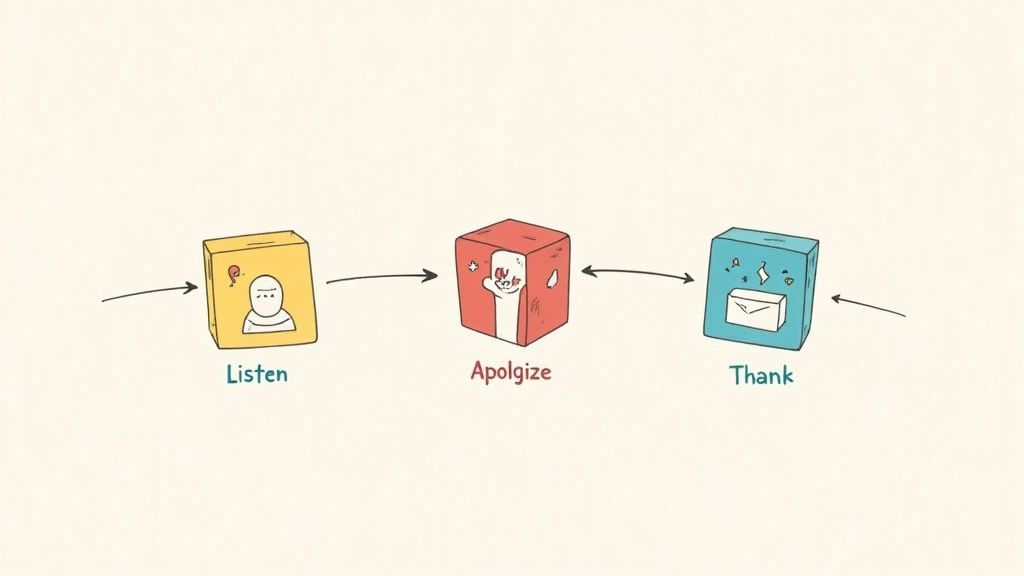
This method isn't just a script; it's a problem-solving methodology. Companies known for efficient, large-scale support, like Amazon and Microsoft, implement similar structured approaches for handling returns and technical issues. By using a consistent framework, they ensure a high standard of service across millions of interactions, making customers feel their concerns are handled thoroughly and methodically.
How to Use This Template
The strength of the LAST method lies in its sequential flow. Each step builds on the last, guiding the conversation from acknowledgment to resolution and ending on a positive note. It's one of the most effective customer service response templates for training new agents.
Template Structure:
"Hi [Customer Name],
Thank you for sharing the details about [restate the problem to show you've listened].
I'm very sorry for the inconvenience this has caused. It's clear that we fell short of the mark, and I apologize for the frustration.
To resolve this, I have [state the specific solution or action taken]. You should see this reflected in your account within [timeframe].
Thank you for your patience and for bringing this to our attention. We appreciate your business.
Sincerely,
[Your Name]"
Actionable Tips for Implementation
- Customize Each Step: While the structure is fixed, the content should not be. Tailor the apology, solution, and thank you to the specific customer and their unique problem.
- Use Transitional Phrases: Smoothly connect the steps. Use phrases like, "Now that I understand the issue, here's what I can do to fix it," to move from Apologize to Solve.
- Train for Flexibility: Teach representatives when it's appropriate to deviate. For example, a minor issue might not require an extensive apology, while a major one may need more emphasis on the "Solve" step.
3. Solution-First Template
For customers who value speed and efficiency above all else, the Solution-First Template cuts directly to the chase. This direct approach leads with the resolution, providing the answer or next steps at the very beginning of the message. It is a powerful customer service response template for straightforward issues where the customer is looking for a quick fix, not a lengthy conversation. By presenting the solution upfront, you respect the customer's time and demonstrate competence.

This method is heavily utilized by tech support departments and e-commerce platforms that handle high volumes of clear-cut problems. Companies like Apple Support often provide immediate troubleshooting steps, while UberEats quickly offers a credit for a missing item. This tactic is effective because it immediately resolves the customer's primary concern, building confidence and satisfaction through sheer efficiency.
How to Use This Template
The template's effectiveness lies in its inverted structure: solution first, context second. This assures the customer that their problem is already being handled before they even read the details.
Template Structure:
"Hi [Customer Name],
We've gone ahead and [state the solution, e.g., processed a full refund for your order / reset your password]. You should see [expected outcome, e.g., the credit in your account within 3-5 business days / an email with a reset link in your inbox shortly].
I saw that [mention the problem, e.g., your delivery was marked as incomplete], and I've made sure this is corrected for you.
Please let me know if there's anything else I can help with.
Best,
[Your Name]"
Actionable Tips for Implementation
- Use for Simple, Repeat Issues: This template is perfect for common, low-complexity problems like password resets, refund requests, or tracking number inquiries where the solution is definitive.
- Ensure Accuracy: The solution you provide must be 100% correct and complete. Providing an incorrect fix upfront will cause more frustration than a standard, empathetic response.
- Follow Up with Context: While the solution comes first, briefly explain why the issue occurred if it adds value. For example, "This was due to a temporary system glitch that has now been resolved."
- Soften the Tone: Since this approach is very direct, end the message with warm, relationship-building language like, "We really appreciate you as a customer," to avoid sounding robotic.
4. Educational Template
Solving a customer's problem is good; teaching them how to avoid it in the future is even better. The Educational Template is one of the most proactive customer service response templates, designed not just to fix an issue but to empower the customer with knowledge. This approach turns a support ticket into a learning opportunity, reducing repeat inquiries and helping customers get more value from your product or service.

This method transforms your support team into product experts and educators. Companies like HubSpot and Adobe excel at this, often including detailed explanations, links to tutorials, or best practice tips within their support responses. By educating users, you build their confidence and proficiency, which directly contributes to higher customer satisfaction and long-term retention.
How to Use This Template
The goal is to provide a clear solution while also offering valuable context. This template first solves the immediate need and then provides educational resources for deeper understanding, giving the customer control over how much they want to learn.
Template Structure:
"Hi [Customer Name],
Thanks for your question about [specific feature or problem]. I'm happy to help you with that!
Here are the steps to [achieve their goal]:
- [Step 1]
- [Step 2]
- [Step 3]
To help you get the most out of this feature in the future, I've also included a quick guide that explains [related process or best practice]. You can find it here: [Link to Knowledge Base Article or Video].
Let me know if you have any more questions!
Best,
[Your Name]"
Actionable Tips for Implementation
- Use Visual Aids: A picture is worth a thousand words. Use screenshots, GIFs, or short video clips to illustrate complex steps. This is especially effective for software or technical support.
- Break It Down: Structure information with numbered lists, bullet points, and bold headings. This makes your instructions easy to follow and less intimidating than a dense paragraph.
- Link to Resources: Don't reinvent the wheel in every email. Link directly to relevant help docs, blog posts, or video tutorials. This helps you maintain a single source of truth and saves time.
5. Escalation and Ownership Template
Not every issue can be solved by the first person who answers the call. The Escalation and Ownership Template is a crucial customer service response template for managing situations that require specialized knowledge or authority. Its purpose is to create a seamless and confident handoff, reassuring the customer that their problem is not being dismissed but advanced to the right person for a resolution. This process maintains customer trust and prevents them from feeling passed around.
This method transforms a potentially negative experience into a structured, professional process. Enterprise software companies like Salesforce excel at this, using detailed case tracking to ensure nothing is lost during an escalation. Similarly, financial institutions use this approach for complex issues like fraud claims, providing clear timelines and maintaining communication throughout the investigation.
How to Use This Template
The goal is to communicate three things clearly: why the escalation is happening, who is now responsible, and what the customer can expect next. Taking ownership of the transfer is key to making the customer feel supported rather than abandoned.
Template Structure:
"Hi [Customer Name],
Thank you for explaining the situation in detail. To properly resolve [restate their specific problem], I need to escalate your case to a specialist on our [Name of Team, e.g., Technical Support, Billing] team who has the right expertise to solve this for you.
I have documented everything we discussed under case number [#12345] to ensure a smooth handoff. [New Agent Name or The Team] will reach out to you within [Timeframe, e.g., 2-4 hours]. You are in great hands, and we will see this through to a solution.
Sincerely,
[Your Name]"
Actionable Tips for Implementation
- Provide a Reference Number: Always give the customer a specific case or ticket number. This empowers them and makes future follow-ups much easier.
- Set Realistic Timelines: Be specific and honest about when they can expect the next communication. Avoid vague promises like "as soon as possible."
- Explain the 'Why': Briefly clarify why the escalation is necessary. Phrases like "to our senior technician with advanced tools" or "to our secure payments team" build confidence in the process. More advanced AI customer service automation can often handle these handoffs seamlessly. You can learn more about how AI enhances customer support on yoonoo.ai.
- Ensure a Warm Handoff: Internally, make sure all relevant notes and customer history are transferred to the next agent so the customer doesn't have to repeat themselves.
6. Proactive Communication Template
The best customer service interaction is the one that never has to happen. The Proactive Communication Template flips the traditional support model by addressing potential issues before a customer even thinks to reach out. This forward-thinking approach involves contacting customers first about known problems, upcoming changes, or service interruptions, demonstrating transparency and care that builds immense loyalty.
This strategy prevents a flood of support tickets and transforms a potentially negative experience into a positive one. Companies like Netflix and major airlines excel at this. When Netflix detects a service outage, they often display a message before you can even search for an error. Similarly, airlines proactively text passengers about flight delays, providing rebooking options and saving them a stressful trip to the gate agent.
How to Use This Template
The goal is to be clear, concise, and helpful. Inform the customer about the situation, explain what it means for them, and provide clear next steps or a timeline for resolution. This reduces customer anxiety and shows you are in control.
Template Structure:
"Hi [Customer Name],
We're writing to let you know about [the specific issue, e.g., a brief service outage, an upcoming maintenance window, a potential shipping delay].
This means [explain the direct impact on the customer]. We expect this to be resolved by [time/date].
You don't need to take any action at this time. We will notify you as soon as everything is back to normal. We apologize for any inconvenience this may cause.
Thanks,
[Your Name/Team]"
Actionable Tips for Implementation
- Segment Your Audience: Don't send a mass email if an issue only affects a specific group of users. Target communications based on location, subscription plan, or recent activity to ensure relevance.
- Provide Clear Next Steps: If the customer needs to do something, make it obvious. For example, "Please log out and log back in to see the update," or "Click here to track your rescheduled delivery."
- Use Multiple Channels: For critical alerts like potential fraud or major outages, don't rely on a single channel. Use a combination of email, SMS, and in-app notifications to ensure the message is received.
- Automate Where Possible: Many proactive messages can be triggered automatically. Learn more about how an AI customer support chatbot can help identify issues and send these communications for you.
7. Personalization and Relationship Building Template
Moving beyond a one-size-fits-all approach, the Personalization and Relationship Building Template transforms a standard interaction into a memorable experience. This template leverages customer history, preferences, and past interactions to show the customer they are seen as an individual, not just a ticket number. It’s about creating responses that feel tailor-made, strengthening loyalty by demonstrating genuine attention and care. This strategy makes the customer feel valued and understood on a deeper level.
This high-touch approach is a hallmark of luxury retail and high-end service providers. Think of how Amazon personalizes support based on your recent purchase history or how a Nordstrom personal shopper might reference your style preferences from a previous visit. These customer service response templates prove you’re not just solving a problem; you’re continuing a relationship.
How to Use This Template
The goal is to seamlessly integrate a piece of personal information to show you've done your research. This small detail validates their history with your brand and makes the current interaction feel more connected and less transactional.
Template Structure:
"Hi [Customer Name],
Thanks for getting in touch about [current issue]. I was just looking at your account and saw you're a big fan of our [previous product/feature]. It’s great to have you as a loyal customer.
Regarding your question about [current issue], here is the information you need: [Provide clear, direct solution].
Let me know if that helps, or if there's anything else I can assist you with!
Best,
[Your Name]"
Actionable Tips for Implementation
- Verify Information: Always double-check that the personal information you're referencing is accurate. Using incorrect details can be more damaging than not personalizing at all.
- Balance Personalization and Efficiency: Don't spend so much time researching a customer that it creates a long delay. Reference one key detail that is easy to find in their CRM profile.
- Note Communication Style: Pay attention to the customer's tone. If they are formal, keep your response professional. If they are more casual, you can mirror that style in your reply.
- Update Customer Profiles: Use each interaction as an opportunity to enrich the customer’s profile. Note their preferences or issues so the next agent can provide even better, more personalized service.
8. Recovery and Retention Template
When a significant issue occurs, the goal shifts from simply solving a problem to actively saving the customer relationship. The Recovery and Retention Template is a strategic customer service response template designed for high-stakes situations where loyalty is at risk. It focuses on service recovery, relationship repair, and providing exceptional value to transform a negative experience into a powerful loyalty-building moment.
This approach goes beyond a standard apology. It's about a grand gesture that acknowledges the severity of the failure and demonstrates an unwavering commitment to making things right. This principle is famously seen in JetBlue's comprehensive response to flight disruptions, where they offered travel vouchers and a public apology, and Johnson & Johnson's legendary handling of the Tylenol crisis, which set the gold standard for corporate responsibility and customer trust.
How to Use This Template
This template is for critical incidents where the customer is justifiably upset and likely to churn. It combines a sincere apology with a significant, value-added offer that more than compensates for the inconvenience.
Template Structure:
"Hi [Customer Name],
I am writing to you personally to extend my sincerest apologies for the [describe the significant problem in detail] you experienced. This is not the standard of service we aim to provide, and we failed to meet your expectations.
To make this right, we have [state the immediate fix]. Additionally, as a gesture of our apology and to thank you for your patience, we would like to offer you [specific, high-value compensation, e.g., a full refund, significant store credit, a free premium product].
We are taking this issue very seriously and are [mention internal step, e.g., reviewing our processes] to prevent it from happening again. We deeply value your business and hope to have the opportunity to restore your confidence in us.
Sincerely,
[Your Name/Manager's Name]"
Actionable Tips for Implementation
- Move Quickly: The speed of your response is critical. A swift, decisive action shows the customer their issue is a top priority.
- Overcompensate: The compensation should feel generous and exceed the customer’s expectations. The goal is to create a "wow" moment that overshadows the initial negative experience.
- Follow Up Personally: After the resolution, have a manager or senior team member follow up to ensure the customer is completely satisfied. This personal touch reinforces their value.
- Learn and Improve: Document the failure and the resolution. Use the incident as a case study to train your team and improve internal processes, turning a negative into a long-term operational positive.
Customer Service Response Templates Comparison
| Template | Implementation Complexity | Resource Requirements | Expected Outcomes | Ideal Use Cases | Key Advantages |
|---|---|---|---|---|---|
| Acknowledgment and Empathy | Moderate (requires training) | Skilled representatives, empathy training | Builds trust, reduces escalation, emotional connection | Complex complaints, emotional customers | Defuses anger, builds rapport, trust |
| LAST Method | Low to Moderate (structured) | Training on process, documentation | Consistent responses, measurable improvements | Broad use, varied issues | Clear structure, easy to train, trackable |
| Solution-First | Low | Minimal training, focus on solutions | Quick resolution, reduced customer anxiety | Simple, straightforward issues | Time-saving, efficient, demonstrates competence |
| Educational | High (requires expertise) | Product experts, content creation | Reduced future tickets, increased product knowledge | Complex products, frequent issues | Builds confidence, reduces repeat requests |
| Escalation and Ownership | Moderate | Coordination between teams, case management | Maintains customer confidence during escalation | Issues needing higher-level support | Clear ownership, timeline setting, accountability |
| Proactive Communication | High | Advanced tracking/prediction systems | Fewer complaints, improved loyalty and retention | Known issues, status updates | Prevents frustration, proactive service |
| Personalization and Relationship | High | CRM systems, data analysis | Stronger loyalty, increased sales opportunities | High-value customers, repeat buyers | Tailored responses, relationship strengthening |
| Recovery and Retention | High | Senior approval, compensation budget | Customer loyalty recovery, stronger relationships | Service failures risking customer loss | Turns detractors to promoters, shows commitment |
Putting Your Templates into Action with Smart Automation
Throughout this guide, we’ve explored a powerful arsenal of customer service response templates, each designed to address specific scenarios with precision and empathy. From the foundational Acknowledgment and Empathy template to the strategic Recovery and Retention model, you now have a blueprint for creating consistently positive support interactions.
The true value of these templates isn't just in having them, but in how you deploy them. They are more than simple scripts; they are frameworks for building trust, demonstrating competence, and showing genuine care. Mastering their use transforms your customer service from a reactive cost center into a proactive engine for growth and loyalty.
From Static Scripts to a Dynamic Support System
Remember, the goal is not to sound like a robot. The best support teams use these templates as a launchpad, not a cage. They provide a reliable structure that ensures no critical step is missed, from active listening with the LAST method to taking decisive ownership during an escalation.
Think of it this way:
- Consistency: Every customer receives the same high standard of care, regardless of which agent they speak to.
- Efficiency: Your team spends less time figuring out what to say and more time focusing on how to solve the customer's unique problem.
- Scalability: As your business grows, these templates allow you to onboard new team members quickly and maintain quality without missing a beat.
The ultimate takeaway is that effective customer service response templates empower your team to be more human. By handling the structural part of the conversation, they free up your agents' mental energy to focus on active listening, personalization, and creative problem-solving. This combination of structured efficiency and genuine empathy is what sets world-class support teams apart.
Next Steps: Weaving Templates into Your Workflow
Having a library of well-crafted responses is the essential first step. The next is to integrate them seamlessly into your daily operations. This is where modern tools can amplify your efforts and turn a good support strategy into a great one. Consider how smart automation can deploy these proven frameworks at scale, handling common queries 24/7.
By combining the powerful templates we’ve discussed with intelligent automation, you create a seamless support ecosystem. This system is not only consistently helpful but also deeply personal, driving the kind of customer satisfaction that builds lasting loyalty and turns customers into advocates.
Ready to elevate your customer support with intelligent automation? Build a no-code AI chatbot with Yoonoo that learns directly from your website and help documentation. Yoonoo can instantly deploy these proven response structures, freeing your team to handle high-value interactions while ensuring every customer gets the fast, accurate help they deserve.