AI Customer Service Automation Your Business Can Trust
Let's be honest, "AI customer service automation" sounds a bit like corporate jargon. But what are we really talking about?
Think of it less as a robot taking over and more like your most efficient team member—the one who never sleeps, never has a bad day, and has memorized every single help article you've ever written.
This isn't your old-school, clunky chatbot that just spits out pre-written answers. Modern AI automation is smart. It actually reads a customer's question, understands what they really mean, and gives them a precise answer pulled from your knowledge base, FAQs, or even past support tickets. It learns and gets better with every single conversation, just like a human agent does.
What Does AI Customer Service Automation Really Do
So, what does this look like in practice? Imagine a customer landing on your website at 2 AM with a simple question, like "Where's my package?" or "How do I reset my password?"
Instead of them having to wait until morning, an AI-powered system instantly provides the answer. It frees up your human support team to focus on the tougher, more nuanced problems where a human touch really makes a difference.
Your Digital Concierge in Action
This "digital concierge" is more than just a Q&A machine. It actively manages the customer experience in ways that used to require a person.
- Instant Triage: The moment a query comes in, the AI figures out what the customer needs. If it's a simple fix, it handles it right there. If it's more complicated, it intelligently routes the ticket to the right human agent, complete with all the background context.
- 24/7 Availability: It’s always on. Customers get the same high-quality support whether it's midnight on a Tuesday or the middle of a holiday weekend. No more waiting.
- Personalized Responses: By connecting to your other systems, like a CRM, the AI can greet customers by name and pull up their order history to give them truly personal and relevant help.
This isn't just a niche tool anymore; it's quickly becoming the standard for how support gets done. Projections show that by 2025, AI will be involved in roughly 95% of all customer interactions.
And it’s not just about answering questions. A Gartner forecast predicts that by 2026, 10% of agent interactions will be completely automated. That’s a huge jump from just 1.6% a few years back, showing just how fast companies are adopting this technology. If you want to dive deeper, you can find more AI customer service stats and trends on Fullview.io.
At its core, AI customer service automation is about creating efficiency at scale. It removes repetitive friction from your support process, enabling faster resolutions and allowing your team to focus on building meaningful customer relationships.
This technology isn't just a fleeting trend. It's a fundamental change in how businesses can deliver fast, effective, and satisfying support. By letting AI handle the routine, you empower your team to handle the relationships.
The Building Blocks of Your AI Support System
A great AI customer service setup isn't just one piece of software. It’s more like a well-oiled machine with several key parts working together. Think of it like a company's departments—each has its own job, but they all need to cooperate to create a smooth experience for the customer.
When you understand how these individual parts function, you start to see how a simple chatbot can grow into a powerful, comprehensive support engine. Let's dig into the three core pillars that underpin any modern AI support system.
The image below breaks down how these components work together to deliver real business results, like cutting costs, speeding up service, and keeping customers happy.
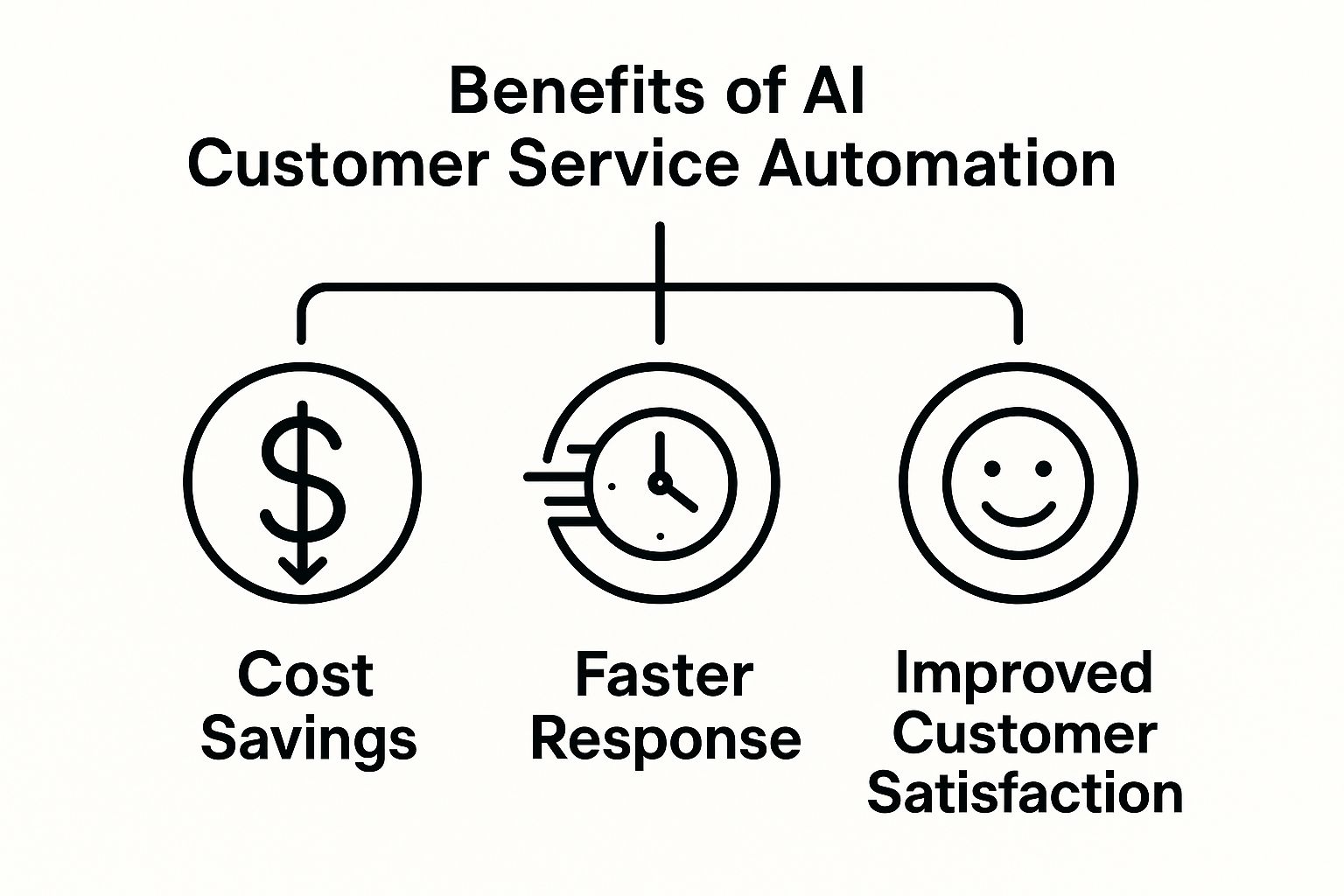
It’s this teamwork between the different AI tools that really moves the needle, making your operations more efficient while giving your customers a much better experience.
Chatbots and Virtual Assistants
Think of chatbots and virtual assistants as the friendly faces on your digital frontline. They're often the first point of contact for a customer, ready to jump in 24/7 to field common questions and requests. Their main purpose is to give people instant answers.
These aren't the clunky, frustrating bots from a few years ago. Today's AI agents can actually understand what people are asking in plain English, figure out what they need, and solve simple problems on their own. This kind of immediate help is exactly what customers expect now—no waiting in a queue for a human. Our guide offers more detail on how to get the most from an AI customer support chatbot.
These bots are perfect for handling repetitive tasks like:
- Checking on an order's status
- Starting a return
- Answering basic FAQs
- Helping with password resets
By letting bots handle these predictable conversations, which often make up a huge chunk of your support tickets, you free up your human agents to focus on the tougher, more nuanced problems.
Intelligent Routing Systems
So, what happens when a chatbot gets a question it can't answer? That’s where intelligent routing comes in. This is the expert dispatcher of your support system. It doesn’t just blindly forward a customer to the next person in line.
Instead, the AI looks at the conversation—the customer's words, their tone, and the specific problem—to figure out exactly who can help. For instance, a highly frustrated customer with a complicated billing question gets sent straight to a senior specialist in the billing department, bypassing the general queue entirely.
Intelligent routing makes sure complex problems land with the right person on the first try. It cuts out those annoying internal transfers and drastically reduces the time it takes to solve the issues that really matter.
For the customer, the whole process feels seamless. They aren't being bounced around; they're just getting connected to the expert who can actually fix their issue. This not only makes customers happier but also makes agents more effective, since they're only getting tickets they’re truly equipped to handle.
AI-Powered Knowledge Bases
The last piece of the puzzle is an AI-powered knowledge base. This is the central brain for your entire support operation. It’s the single source of truth that feeds both your automated tools and your human agents, holding all your help articles, how-to guides, and internal docs.
AI takes a standard knowledge base and puts it on steroids. It can sift through support chats to spot "knowledge gaps"—topics where customers are asking questions but no help article exists. It can even help your team write clearer, more effective support content.
For your chatbots, this knowledge base is where they pull their answers from. For your human agents, it acts like a co-pilot, automatically suggesting the right help article or canned response during a live chat. This ensures every customer gets a consistent and accurate answer, no matter who they talk to.
Real Business Wins from Automating Customer Support
Let's get down to brass tacks. Bringing AI customer service automation into your business isn't just about having the latest tech—it's about seeing real, measurable results that show up on your balance sheet. The real magic happens when you look past the buzzwords and see the tangible impact on costs, efficiency, and customer happiness.
This isn't just a hypothetical benefit. We're seeing businesses completely change their support game by letting AI handle the repetitive stuff. This move frees up their human teams to focus on what they do best and fundamentally reshapes the economics of customer service, turning a cost center into a genuine growth driver.
Slashing Operational Costs
One of the first things you'll notice is the impact on your operational budget. Think about what it takes to have a support team available 24/7. The costs of hiring, training, and paying agents to cover all hours—including nights, weekends, and holidays—add up fast. It's a huge investment.
AI offers a much more sustainable way to handle the flow of customer questions without constantly adding to your payroll. A single AI assistant can manage thousands of conversations at once, meaning no customer is left waiting, all for a fraction of what it would cost to staff a human team of that size.
This lets you scale up your support capacity without your expenses skyrocketing. In fact, businesses often see their operational costs drop by around 30% by making their support processes smarter and more efficient. For a deeper dive into the numbers, check out these impactful AI statistics on Desk365.io.
A great example is handling a surge in questions during a holiday sale or a new product launch. Instead of scrambling to hire temporary staff or burning out your team, automation simply absorbs the extra volume.
This efficiency gives you direct savings. Your human agents are no longer bogged down answering the same basic questions all day. Instead, they can focus their brainpower on complex problems that require a human touch—the kinds of interactions that build real relationships.
Supercharging Speed and Efficiency
In customer support, speed is everything. We've all been there—stuck in a queue, waiting for a simple answer. Those delays are a direct path to frustration and lost customers. AI tackles this problem head-on by delivering instant, around-the-clock answers to common questions.
A customer needing to track an order or reset a password can get help immediately instead of waiting for an agent. This massive improvement in response time is a total game-changer for the customer experience.
Here’s a quick look at how AI makes everything faster:
- Faster Fixes: AI tools can slash average resolution times by up to 50%. Customers get what they need and can get on with their day.
- Instant First Contact: We see an average improvement of 37% in first response times, cutting out that initial wait that drives everyone crazy.
- Always-On Support: Your support is never closed. Whether it's 3 PM on a Tuesday or 3 AM on a Sunday, customers get the same great service, which builds a ton of trust.
For many growing companies, finding the right chatbot for a small business is the perfect first step to achieving this new level of speed and availability.
Fostering Customer Loyalty and Growth
At the end of the day, great service is about building strong relationships. A fast, easy, and consistently helpful support experience is what keeps people coming back. When customers know they can count on you to solve their problems without a hassle, they're far more likely to stay loyal and tell their friends about you.
This improved experience feeds directly into business growth. Happy customers stick around longer and are more forgiving if a mistake happens. By using AI to flawlessly handle the basics, you set a high standard of service that makes your brand the easy choice.
Automation also acts as an incredible source of insight. By analyzing the most common questions, you can pinpoint confusing parts of your customer journey, find opportunities to improve your products, and even create help articles that answer questions before they're ever asked. It’s a smart, data-backed way to keep getting better.
The table below gives a snapshot of how these changes look in practice, using typical industry data to show the before-and-after picture.
Impact of AI Automation on Customer Service Metrics
| Metric | Before AI Automation | After AI Automation | Improvement |
|---|---|---|---|
| First Response Time | 2.5 hours | 15 minutes | -90% |
| Average Resolution Time | 4.8 hours | 2.4 hours | -50% |
| Cost Per Interaction | $8.00 | $5.60 | -30% |
| Customer Satisfaction (CSAT) | 82% | 90% | +8% |
| Agent Productivity | 15 tickets/hour | 22 tickets/hour | +47% |
As you can see, the improvements are substantial across the board. By automating intelligently, businesses don't just save money—they create a faster, more reliable service that customers genuinely appreciate.
How Leading Brands Use AI in Customer Service
It’s one thing to talk about theory, but seeing AI customer service automation in action is where things get interesting. Smart companies aren't just dabbling in AI; they're rebuilding their entire support strategy around it to deliver service that’s faster, more accurate, and just plain better.
These brands prove that AI isn’t about getting rid of human agents. It’s about enhancing them. By letting bots handle the simple, repetitive stuff, their teams are free to tackle the truly complex problems where a human touch makes all the difference.
Let's look at a few real-world examples to see how this plays out.
E-commerce Giants Mastering Order Management
If you run a major online store, you know the drill. You're swimming in a constant sea of customer questions, and most of them are about the same three things: order status, returns, and exchanges. One leading e-commerce brand decided to tackle this head-on by putting an AI-powered chatbot on its website and app.
This wasn't just any chatbot. It was fully connected to their backend logistics, so it could give real-time, personal updates. A customer could just type, "Where's my order?" and get an instant, accurate answer without ever needing to talk to a person.
The impact was huge:
- Reduced Ticket Volume: The chatbot now fields over 60% of all support questions, which means thousands of repetitive tickets just disappear every day.
- Faster Resolutions: What used to take a few minutes of an agent’s time is now handled in seconds.
- Improved Agent Focus: The human support team can finally focus on the tricky stuff—like dealing with damaged products or answering detailed questions—where their expertise really counts.
This setup gives customers the quick answers they crave and makes the support team's job far more meaningful.
SaaS Companies Delivering Instant Technical Support
For a Software-as-a-Service (SaaS) business, great technical support is everything. It's what keeps customers happy and subscribed. One fast-growing SaaS provider was drowning in technical questions, and the frustrating part was that most of the answers were already buried in their help docs.
Their solution was to build an AI-driven knowledge base. This system does more than just store articles; it actually understands what users are asking and pulls up the exact piece of information they need. Now, when a user asks a technical question in the chat widget, the AI scans the entire help center and delivers a specific answer or guide.
By making its help content smarter and easier to access, the company empowered users to solve problems themselves. This self-service model led to a stunning 40% reduction in support ticket volume in just six months.
This didn't just slash support costs. It made for a much better user experience by giving people immediate answers instead of making them wait for an agent. It’s a classic win-win, showing how AI can turn a static help center into a dynamic, problem-solving machine.
Travel Companies Navigating Disruptions Proactively
The travel industry is a rollercoaster. Flight delays and cancellations can create a nightmare for customers and a massive spike in calls for support teams. One major travel company is using AI to get ahead of these disruptions.
Their AI system keeps an eye on flight data 24/7. The moment it flags a delay or cancellation, it kicks off a chain of events:
- Proactive Alerts: It immediately sends a text or email to affected passengers, often before the airline even makes an official announcement.
- Self-Service Rebooking: The alert includes a link to an AI-powered portal where passengers can see their options and rebook a new flight with a single click.
- Intelligent Triage: If a customer still needs to call, the AI knows exactly what's going on and routes them to a specialized agent who is already up to speed.
This kind of proactive automation has dramatically cut down call center wait times during travel chaos and kept customers much happier. The confidence in this approach is growing across the board. In fact, a recent survey found that 72% of business leaders think AI can handle many support tasks better than humans, thanks to its speed and availability.
If you're curious, you can discover more insights about emerging trends in customer service to see how this is changing the industry. As these examples show, AI isn't some far-off concept—it's here now, solving real problems and delivering real results.
Here is the rewritten section, designed to sound like an experienced human expert:
Your Roadmap to Implementing AI Automation
So, you're ready to bring AI into your customer service. It can feel like a massive undertaking, but the secret is to not boil the ocean. A smart, phased approach is your best bet. Think of it less like flipping a switch and more like building a solid foundation, one brick at a time.
The real goal here is to get some quick wins on the board. When you automate the right things first, you show immediate value, get your team excited, and build momentum for the bigger projects down the road. This is your game plan for getting from A to B successfully.
Start with the Low-Hanging Fruit
Before you even look at a single piece of software, look at your own data. The absolute best place to start is with the questions your support team is tired of answering. You know the ones—the same, repetitive queries that pop up dozens of times a day. These are your "low-hanging fruit."
Dig into your support ticket history. What patterns jump out? What are the top five or so questions that clog up the queue? It’s almost always things like:
- "Where's my order?"
- "How do I reset my password?"
- "What's your return policy?"
- "When are you open?"
These are perfect candidates for automation because the answers are straightforward and don't change. Automating them gives customers the instant gratification they crave and frees up your agents to handle the truly tricky issues that require a human touch.
Choose the Right AI Platform
Okay, now that you know what you want to automate, it's time to find the right tool. The market is flooded with options, from basic chatbot builders to complex, enterprise-grade platforms. The trick is finding the one that actually fits your needs, your team's technical skills, and your budget.
Here’s what to keep in mind when you're shopping around:
- Ease of Use: Can your team actually use this thing without calling in a developer for every little change? Look for intuitive, no-code solutions that put your support managers in the driver's seat.
- Integration Capabilities: A standalone bot is a dead end. You need a platform that plays nicely with the tools you already use—your CRM, e-commerce platform, and help desk. This is non-negotiable for providing support that feels personal and aware of the customer's history.
- Scalability: Will this tool grow with you? You might be starting simple, but you'll want a platform that can handle more sophisticated workflows as your strategy evolves.
For a lot of businesses, a tool like Yoonoo that can learn directly from your website is a great starting point. It cuts down the setup time dramatically and gets your AI helping customers almost immediately.
Train Your AI to Sound Like You
An AI is basically an empty vessel. The training phase is where you pour in your company's knowledge and personality, turning a generic tool into a genuine extension of your brand.
The point of training isn't just about spitting out correct facts. It's about delivering those facts in a voice that feels like your company. This is how you maintain a consistent experience, whether a customer is talking to a person or a bot.
Get started by feeding the AI your core sources of truth:
- Your Website Content: Let the AI crawl your product pages, FAQs, and company info.
- Your Knowledge Base: If you have help articles and guides, upload them all. This is gold.
- Past Support Conversations: Using anonymized chat and email transcripts can teach the AI the nuances of how your team talks to customers and solves problems.
This process is what ensures your AI doesn't sound like a robot, but like a helpful member of your team.
Integrate and Test Like Crazy
With your AI trained up, the next step is to plug it into your actual workflow. This is what separates a simple chatbot from a true AI customer service automation engine. Connect it to your CRM so it can pull up a customer's history or to your Shopify store so it can give real-time order updates.
Now, before you unleash it on your customers, you have to test it relentlessly. Get a small group of internal folks to act as secret shoppers. Have them throw every question imaginable at the AI—the easy ones, the weird ones, the tricky ones. This is your chance to find and fix the awkward replies and knowledge gaps before they can frustrate a real customer.
Launch in Phases and Measure Everything
Whatever you do, don't just flip the switch for everyone at once. That's a recipe for chaos. Roll out your AI in controlled phases. Maybe you start by only putting it on your pricing page, or you only offer it to 10% of your website visitors. This lets you gather real-world data and make tweaks without creating a support nightmare.
And from the very first day, you need to be tracking your key metrics. Watch your ticket deflection rate, first response time, and, of course, customer satisfaction scores. This data doesn't just prove that your investment is paying off; it tells you exactly where to focus your efforts next. This cycle of launching, measuring, and refining is the real secret to building an automation strategy that works.
Balancing Automation with a Human Touch

The best ai customer service automation strategies don't try to replace people. Instead, they make your human team even better. The real magic happens in a hybrid model where technology and people work together seamlessly. The idea isn't to put up a wall of bots, but to let automation handle the repetitive stuff so your team can focus on building relationships.
This balance is absolutely critical. After all, customers still want to talk to a real person, especially when they're dealing with something complicated or frustrating. In fact, over two-thirds of customer experience teams believe AI actually helps them provide the kind of warm, personal service that creates loyal customers. It all comes down to knowing when a bot is best and when you need an expert.
Crafting a Seamless Handoff
When a customer does need a person, the switch from AI to a human agent has to be completely smooth. Nothing is more irritating than a clunky handoff that forces you to repeat everything you just told the bot. That’s a recipe for a bad experience.
To nail this, your system needs to be smart. The AI should be able to spot cues like complex questions, frustrated language, or a direct request to speak with someone. Once a trigger is detected, the system should instantly pass the conversation to the right agent, along with the full chat history.
This way, the agent has all the context they need from the get-go, which saves everyone a lot of time and headache.
The ultimate goal is to use automation to remove friction, not add it. A perfect handoff makes the customer feel helped, not passed around.
Making AI an Agent Co-Pilot
AI's job doesn't end with routing chats. It should also act as a powerful sidekick for your human agents. Think of it as a co-pilot that gives your team superpowers, boosting their efficiency and the quality of their support.
Here’s how AI can support your team in real-time:
- Real-Time Suggestions: During a chat or call, the AI can whisper in the agent's ear, suggesting relevant help articles or canned responses. This ensures every customer gets a fast, accurate answer.
- Instant Summaries: When an agent picks up a long, complicated ticket, AI can provide a quick summary of the entire history. No more scrolling through endless messages to get up to speed.
- Proactive Insights: The AI can analyze a customer's past purchases and interactions to feed the agent helpful tidbits, allowing for a much more personalized conversation.
This approach lets your agents solve tough problems faster and with more confidence. It's about augmenting their skills, not just automating their tasks. In the end, this hybrid model is the key to delivering support that is both incredibly efficient and deeply human.
Got Questions About AI Automation? We've Got Answers.
Jumping into AI customer service automation always brings up a lot of questions. That’s a good thing. It’s a big move, and you want to get it right. We've gathered some of the most common questions we hear from businesses just starting to explore how AI can level up their customer support.
Think of this less as a technical manual and more as a straightforward conversation. It’s not about replacing your team—it’s about giving them superpowers. Let’s clear things up so you can see exactly how this technology fits into your plans for growth.
Will AI Replace My Customer Service Team?
This is always the first question, and for good reason. The short answer? Absolutely not. AI isn't here to take jobs; it’s here to make them better.
Think of AI as a hyper-efficient assistant for your support agents. It handles the flood of repetitive, simple questions that eat up time and lead to burnout. This frees up your human experts to focus on the tricky, high-stakes problems where a human touch and creative problem-solving really make a difference.
The future isn't about people or machines. It’s about them working together. In fact, Zendesk predicts that AI will soon play a part in 100% of customer interactions, whether it’s routing a ticket or feeding an agent the right information at the right time.
How Much Technical Skill Do I Need to Set This Up?
The term "AI implementation" can conjure images of complex code and a team of data scientists. Thankfully, that’s not the reality anymore. Modern AI platforms are built for the rest of us.
Many of the best tools on the market are "no-code" or "low-code." This means your customer support manager—not a developer—can build, launch, and manage your AI system without writing a single line of code. You can often get a surprisingly smart AI chatbot live in minutes just by pointing it to your website or help center articles.
The goal of today’s AI tools is to be user-friendly. You shouldn’t need a technical background to build a great automated support experience for your customers.
What's the Difference Between a Chatbot and AI Automation?
This is a great question because the terms are often used interchangeably, but they're not the same thing. A basic chatbot is like a phone tree. It works from a rigid script and can only respond to specific keywords or commands. If you go off-script, it gets stuck.
True AI customer service automation is in a different league. It uses sophisticated technology like machine learning to understand what your customer means, not just what they type. It can hold a natural conversation, pull answers from different sources, and even take action on the customer's behalf. It's a dynamic, genuinely helpful tool, not just a simple Q&A script.
Ready to see how simple it is to get started? With Yoonoo, you can build and launch a smart AI chatbot that learns directly from your website in just five minutes. Start improving your customer support today at Yoonoo.ai.