A Guide to AI Customer Service Tools

So, what exactly are we talking about when we say "AI customer service tools"? Think of them as software platforms that use artificial intelligence to help manage and improve how you talk to your customers.
These tools, like smart chatbots and automated ticketing systems, can handle all the common, everyday questions around the clock. This 24/7 availability frees up your human agents to focus on the trickier problems that require a human touch.
How AI Is Changing the Game for Customer Support
Picture your customer support team. Now, imagine it transforming from a group of people manually answering every single call and email to a smart, automated network that knows what customers need before they even ask. That’s the kind of jump businesses are making with AI customer service tools.
This isn't just about the clunky, rule-based chatbots of the past. Modern AI has become a genuine partner for support teams.
The real goal here isn't to replace your team, but to supercharge them. By letting AI take care of the repetitive, high-volume questions, your people can focus their brainpower where it truly counts: solving complex issues, building customer relationships, and providing that empathetic support a machine can't. It’s all about creating a smarter, more efficient support system.
What You'll Learn in This Guide
I've put this guide together to give you a clear roadmap, starting from the very basics and building from there. We'll walk through everything you need to know to feel confident bringing this technology into your own business.
Here’s a quick look at what we’ll cover:
- The Basics: We'll break down what these tools are and the simple ideas behind how they work.
- The Big Wins: You'll see the real-world benefits, from saving money to making customers happier.
- Must-Have Features: I'll point out the essential capabilities you should be looking for in any tool.
- Choosing & Implementing: We'll go through a practical plan for picking the right tool and getting it up and running smoothly.
At its core, AI in customer service is about making your support smarter, faster, and more helpful. It's a strategic way to meet the high expectations of today's customers while also making your team's job easier and more fulfilling.
Ultimately, you want to create an experience where customers get answers instantly and your team has the space to do their best work. For a closer look at the nuts and bolts, our post on https://yoonoo.ai/blog/ai-customer-service-automation dives deeper into making your support workflows more efficient. We'll use Yoonoo as our main example to show just how powerful and easy to use these platforms can be.
So, What Exactly Are AI Customer Service Tools?
Ever wish you had a support team that never sleeps, never takes a coffee break, and can chat with thousands of customers at once? That's the essence of AI customer service tools. Think of them as tireless digital assistants who learn from every single conversation to become smarter over time.
At their core, these tools use artificial intelligence to actually understand what a customer is asking. They go way beyond simple, pre-programmed scripts. Instead, they use technology like Natural Language Processing (NLP) to figure out the real intent and even the emotion behind a customer's words.
This means they can do much more than just spit out a canned answer. They can manage a full conversation, diagnose the heart of a problem, and steer customers toward the best solution, all on their own.
The Different Flavors of AI Support Tools
Not all AI tools are built the same. They come in a few different forms, each designed to tackle specific parts of the customer support puzzle. Knowing the difference is key to building a support system that actually works.
Think of these as the essential components of a complete support ecosystem:
- AI Chatbots and Virtual Assistants: These are the ones you see most often. They're the friendly chat windows on websites or in messaging apps that instantly answer common questions like, "Where's my package?" or "How do I reset my password?" A great example is Yoonoo, which you can get up and running in minutes to handle those frontline queries.
- Automated Ticketing Systems: Working behind the scenes, these tools use AI to automatically sort, prioritize, and send support tickets to the right person or team. No more manual sorting—just the right issues getting to the right people, fast.
- Predictive Analytics Engines: This is where things get really interesting. These advanced tools dig into past customer conversations to predict what might happen next. They can spot a customer who's likely to churn or suggest reaching out before a small hiccup turns into a big problem.
When you combine these tools, you're not just answering questions anymore. You're building an intelligent support system that's ready for anything—both reacting to problems and getting ahead of them. It's like having a team that can scale infinitely, where every member is an expert on your business.
This isn't just a futuristic idea; it's quickly becoming the new normal. Projections show that by 2025, AI will be a part of roughly 95% of all customer interactions. And with over 67% of consumers having used a chatbot in the past year, it's clear people are already comfortable with it. If you're curious about the data behind this shift, you can dig into the latest AI customer service statistics on desk365.io. It all points to one thing: these tools are no longer a "nice-to-have" but an essential part of modern business.
Key Benefits of Using AI in Customer Service

Bringing AI customer service tools into your business isn't just about bolting on new software—it’s about rethinking how you operate from the ground up. The perks extend far beyond just faster reply times. They create a powerful ripple effect, boosting efficiency, delighting customers, and ultimately, fueling real growth.
Think of your support team as a busy kitchen staff. Without AI, every single order, from a simple glass of water to an elaborate meal, gets sent to your top chefs. With AI, the simple requests are handled automatically and instantly, freeing up your chefs to focus on the gourmet dishes. That’s the core of AI’s first major benefit.
Massive Gains in Team Efficiency
The first thing you'll notice with AI is its knack for taking over the repetitive, high-volume tasks that bog your team down. This immediately creates a more focused and productive support environment where your agents can apply their skills to problems that actually need a human touch.
This newfound efficiency comes from a few key areas:
- 24/7 Availability: AI tools don't need a coffee break. They're always on, providing instant answers to common questions around the clock. Your customers get help when they need it, not just during business hours.
- Instant Responses: In today's world, speed is everything. AI chatbots can resolve basic queries in a matter of seconds, slashing wait times and leaving customers with a great first impression.
- Intelligent Automation: AI works tirelessly behind the scenes, automatically routing, categorizing, and prioritizing support tickets. This means complex problems land on the right agent's desk faster, without any manual sorting.
By handing off these routine tasks, you empower your human team to become what they should be: expert problem-solvers. They get to spend their valuable time on the complex, sensitive, or high-stakes interactions that demand empathy and critical thinking.
A Superior Customer Experience
A truly great customer experience boils down to three things: speed, consistency, and a personal touch. AI is uniquely built to deliver on all three, helping you forge stronger, more loyal relationships with your customers.
For instance, AI-driven workflows that intelligently route and summarize tickets have been shown to cut average service handle times by a whopping 27%. Plus, with multilingual AI assistants that can work in over 135 languages, you can provide nonstop support globally while your agents tackle the tough stuff. You can dive deeper into these AI market trends to see the full picture.
The real magic of AI in customer service is its ability to provide a consistent, high-quality experience for every customer, every single time. It sets a reliable baseline of service that your human team can then elevate even further.
This consistency is what builds trust. When customers know they can count on getting a quick, accurate answer whenever they reach out, they're far more likely to stick around. By blending the instant efficiency of AI with the nuanced expertise of your team, you create a support experience that truly sets you apart from the competition.
What to Look for in AI Service Tools
Shopping for AI customer service tools can feel a bit like car shopping. From the outside, a lot of them look sleek and promise a smooth ride. But what really matters is what's under the hood. To find a tool that will actually improve your customer experience, you need to look past the shiny exterior and focus on the core features that do the heavy lifting.
Think of it this way: a pretty dashboard is nice, but it's the engine, transmission, and steering that get you where you need to go. Without the right core components, your customer service will just be spinning its wheels.
The image below gives a great snapshot of how businesses are currently using different AI tools. You'll notice chatbots are leading the pack.
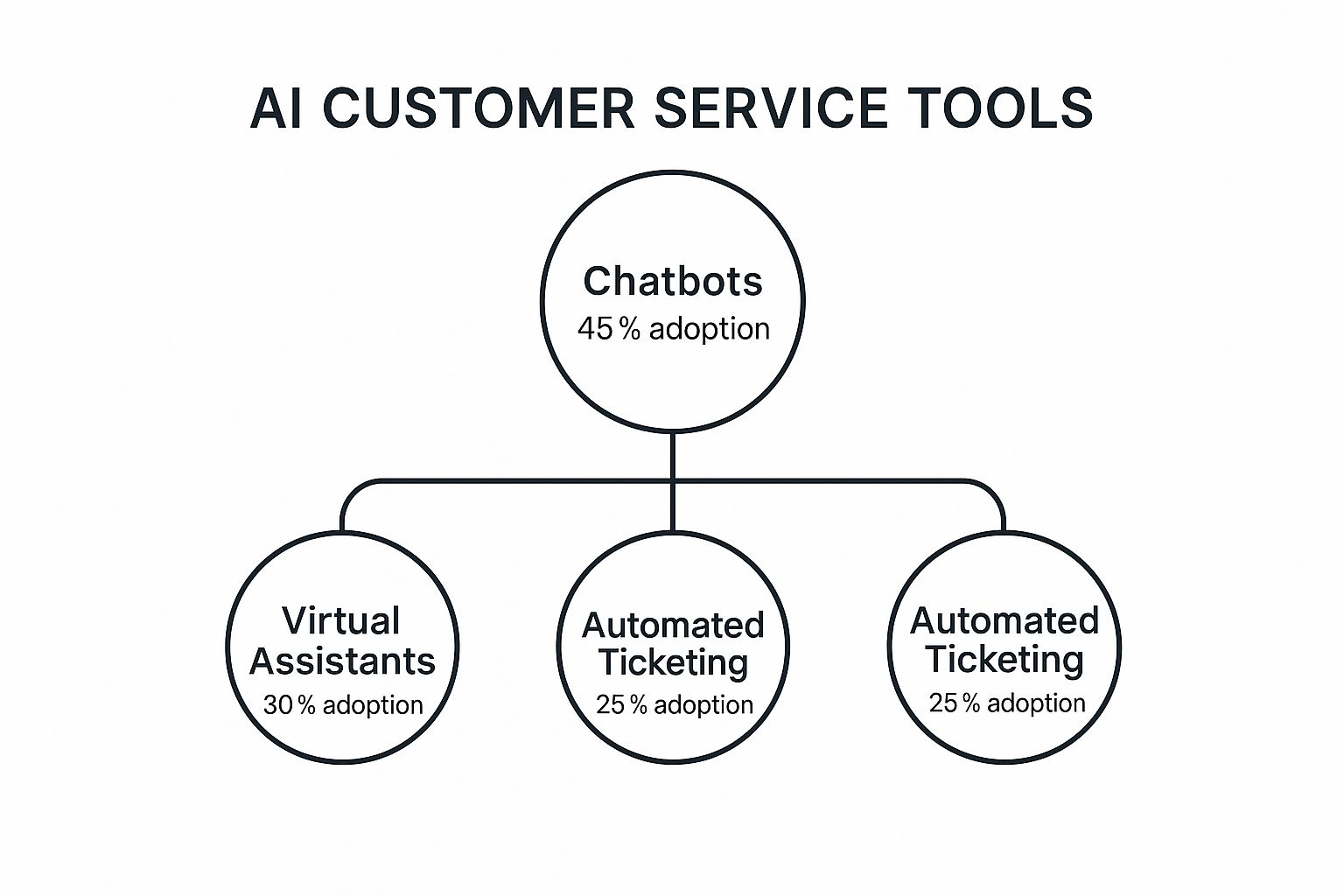
While chatbots are often the first step, a truly powerful setup usually combines several of these tools to create a complete solution.
To help you evaluate what's out there, we've broken down the must-have features. The table below outlines the essential capabilities, what they do, and why they matter for your business.
Key Features of Modern AI Customer Service Tools
A breakdown of essential features, their primary function, and the business benefit they provide, helping you evaluate potential solutions.
| Feature | Primary Function | Key Business Benefit |
|---|---|---|
| Natural Language Processing (NLP) | Understands and interprets human language, including slang, typos, and customer intent. | Enables more accurate, human-like conversations, reducing frustration and errors. |
| Omnichannel Integration | Connects and centralizes conversations across all channels (chat, email, social media). | Provides a seamless customer experience and a single source of truth for your team. |
| CRM/Helpdesk Connectivity | Syncs data with your existing customer relationship management and support software. | Arms agents (and AI) with full customer context for faster, personalized support. |
| Robust Analytics & Reporting | Tracks interaction data, analyzes trends, and measures performance metrics. | Offers actionable insights to improve processes, products, and overall service quality. |
These features are the building blocks of any effective AI customer service platform. Let's dig a little deeper into why a few of them are so critical.
The Brains Behind the Conversation: Natural Language Processing
If there's one feature at the very top of your checklist, it should be Natural Language Processing (NLP). This is the magic that allows an AI to understand how real people talk and write. We're talking slang, typos, messy sentences—the works. An AI tool without solid NLP is like a customer service rep who can only read from a script. It gets stuck easily and isn't very helpful.
Good NLP is what allows the AI to figure out what a customer means, not just what they typed. It’s the difference between a bot that gives up and says "I don't understand," and one that knows "my order's MIA" means "Where is my package?" and immediately pulls up the tracking information.
Playing Nicely With Others: Integrations and Omnichannel Support
Your AI tool can't be a lone wolf; it needs to be part of your pack. It absolutely has to connect smoothly with the other systems you rely on every day, especially your CRM and helpdesk software. This connection gives the AI a complete picture of the customer, allowing it to access order histories or see past support tickets to give personalized, relevant answers.
Just as important is omichannel support. Today's customers don't stick to one channel. They might start a conversation on your website's chat, follow up on social media, and then send an email. A great AI platform brings all of these conversations into one place, so the context travels with the customer. No more making them repeat their story over and over.
A truly integrated AI tool acts as a central hub for your customer support. It connects all the different channels and data points into a single, smart system. This is where a solution like Yoonoo really shines, offering simple integrations that get you up and running without a massive headache.
Seeing the Big Picture: Strong Analytics and Reporting
Last but not least, the best AI tools don't just solve today's problems—they give you the insights to prevent tomorrow's. Look for a platform with powerful analytics. This turns every single customer chat or email into a piece of a larger puzzle.
With good reporting, you can start to:
- Spot Common Problems: Are dozens of people asking the same question? Maybe it's time to update your FAQ or improve your product instructions.
- Measure What Matters: Keep an eye on key metrics like how quickly issues are resolved, customer satisfaction scores, and how well your chatbot is performing.
- Fine-Tune Your Approach: Use real data to make smarter decisions about your support strategy and agent training.
Without analytics, you're just guessing. With them, you have a clear map to guide your improvements.
How to Choose the Right AI Tool

Picking the perfect AI tool isn't about chasing the latest buzzword. It's about finding the right fit for your business and your customers. The most powerful platform on the market is totally useless if it doesn't solve your actual problems or mesh with how your team already works.
So, where do you start? Begin with a good, honest look at your own support operations.
What are your biggest headaches? Are agents swamped with the same basic questions over and over? Do your response times crawl to a halt during busy periods? Nailing down these pain points is the first step. It helps you look for a real solution, not just another piece of software that adds to the complexity.
Define Your Goals and What Success Looks Like
Once you know what’s broken, you need to decide what "fixed" looks like. Vague goals like "make customer service better" aren't going to help. You need to get specific and set clear, measurable targets.
Think along these lines:
- Cut our first-response time by 30% in the next three months.
- Automate 40% of our most common questions to free up agent time.
- Boost our customer satisfaction (CSAT) scores by 15% this quarter.
When you have concrete numbers like these, you can measure every potential AI customer service tool against them. It turns the search from a shot in the dark into a smart, strategic decision.
Choosing an AI tool is an investment. By setting clear goals upfront, you're making sure that investment pays off with real, tangible results that support your company's growth.
Look at the Factors That Matter in the Long Run
With your goals set, you can start vetting different tools. Go beyond the flashy feature list and think about these key things that will affect you long after you’ve signed up.
-
Ease of Use: How easy is this thing for your team to actually use? A tool with a brutal learning curve will just slow everyone down and cause frustration. Look for platforms like Yoonoo that are built for a quick, code-free setup.
-
Scalability: Can this tool grow with you? You need to know that it can handle more customer chats and tickets as your business expands, without the performance tanking or the price suddenly skyrocketing.
-
Vendor Support: What happens when you need help? Solid support from the vendor is a must. Check for responsive customer service, good documentation, and maybe even a community of other users you can turn to.
The market for these tools is exploding. It was valued around USD 13.01 billion in 2024 and is expected to hit nearly USD 83.85 billion by 2033. You can read more about this incredible growth at Grand View Research. All this growth means you have more choices than ever, which makes it even more crucial to pick a partner that truly gets your business.
Best Practices for a Smooth AI Implementation
Getting AI customer service tools up and running successfully is about more than just flipping a switch. You need a solid game plan to turn that shiny new platform into something that actually delivers a return on your investment. A thoughtful strategy ensures the technology works for your team, not against them.
The best way to get started? Think small. Instead of a massive, company-wide rollout that could cause chaos, kick things off with a focused pilot project. Pick one specific area to test the waters, like automating the answers to your top three most frequently asked questions. This gives you a controlled space to learn and tweak things without disrupting your entire support operation.
Train Your AI for Success
An AI is only as good as the information you give it. If you feed it generic data, you'll get generic, unhelpful answers that frustrate customers. To get your AI to sound like your brand and actually solve problems, you have to train it on your own company-specific data.
This means uploading things like:
- Your Knowledge Base: Every help article, FAQ, and product guide you have.
- Past Conversations: Use scrubbed transcripts from old support chats and emails so it can learn how real issues are solved.
- Brand Guidelines: Make sure the AI's personality and tone of voice are a perfect match for your brand.
When you do this, you’re not just turning on a piece of software; you're building a digital expert that knows your business inside and out. This is a non-negotiable step for any AI customer support chatbot because its accuracy depends entirely on this training.
Prepare Your Team for New Roles
Your human agents are the most important part of this whole process. It's crucial to get them ready for their new roles as AI supervisors and problem-solving specialists. They'll be moving away from answering the same easy questions over and over and shifting their focus to the complex issues that truly require a human touch.
A smooth AI implementation is a team sport. It’s about blending smart technology with an empowered human team to create a support experience that’s both incredibly efficient and genuinely personal.
Finally, make sure you set up clear Key Performance Indicators (KPIs) right from the beginning. Start tracking metrics like first-response time, ticket resolution rate, and customer satisfaction (CSAT) scores immediately. This data doesn't just prove the value of your new tools; it shows you exactly where you can keep making improvements.
Got Questions About AI Support Tools? We've Got Answers.
Jumping into AI for your customer service can feel like a big step. It’s natural to have questions pop up, especially around things like cost, setup, and what it all means for your team. Let's walk through some of the most common concerns and get you some clear answers.
Will AI Replace My Human Support Team?
This is probably the number one question we hear, and it comes from a place of genuine concern for team members. It's a total myth.
The point of AI isn't to replace your people; it's to supercharge them. Think of an AI tool as a super-efficient assistant that takes all the repetitive, straightforward questions off your team's plate.
This frees up your human agents to focus on the complex, high-value conversations—the stuff that requires real empathy and creative problem-solving. AI handles the routine, so your team can handle the relationships.
What's This Going to Cost? And What About ROI?
Okay, let's talk about the price tag. The cost of AI tools can vary a lot, with some based on a monthly subscription and others on how much you use them. But fixating only on the initial expense misses the bigger picture.
The real story is the return on investment (ROI). Think about the money saved when your ticket volume drops, your agents become more productive, and your customers stick around because they're happier. A solid AI tool should absolutely pay for itself.
How Hard Is It to Integrate With Our Other Systems?
"Is this going to be a technical nightmare?" That's a fair question. The last thing you want is a new tool that creates more work.
Thankfully, modern AI customer service tools are built to play nicely with the software you already rely on, like your CRM or helpdesk. You should look for platforms that offer simple, no-code integrations. A solution like Yoonoo, for instance, is designed to connect seamlessly without needing a team of developers.
This means your AI gets the context it needs from your other systems to start providing helpful, personalized support right away. It should make your life easier, not more complicated.
Ready to see how easily AI can elevate your customer support? Yoonoo lets you build and launch a smart AI chatbot in just five minutes, no coding required. Start your free trial and begin offering instant, intelligent answers today at https://yoonoo.ai.