How to Improve Online Sales: Proven Strategies for Growth
If you're looking to boost your online sales, you need to think bigger than just a few tweaks here and there. It's about creating a seamless path for your customers, from the moment they find you to the second they click "buy." This means optimizing your website, marketing smarter, and actually using your data to make better decisions. Think of it as turning your entire operation into a well-oiled sales machine.
Your Blueprint for Driving More Online Sales
Just having an online store isn't enough anymore. The digital marketplace is crowded, and turning casual visitors into loyal customers takes a real, actionable plan. This guide cuts through the noise to give you a clear blueprint for genuine growth.
We’re going to get into the nitty-gritty, practical steps that actually move the needle. You'll learn how to build an experience that feels natural and guides shoppers effortlessly from that first click all the way to checkout.
Laying the Groundwork for Growth
Before jumping into specific tactics, it’s crucial to understand the foundational pillars that hold up any successful e-commerce business. These aren't just one-off tasks; they're interconnected strategies that build on each other to create momentum. When you get these fundamentals right, you build a resilient business that's ready for the long haul.
To get a clearer picture of where to focus your energy, I've broken down these core areas into a simple table.
Core Pillars for Improving Online Sales
| Pillar | Key Focus Area | Expected Outcome |
|---|---|---|
| Website Optimization | Making your site intuitive, fast, and trustworthy. | Higher conversion rates and increased customer confidence. |
| Intelligent Marketing | Reaching the right people with the right message. | Better return on ad spend (ROAS) and quality traffic. |
| Data-Informed Decisions | Using analytics to understand what works (and what doesn't). | Continuous improvement and smarter business strategies. |
Nailing these three areas ensures your efforts are concentrated where they'll have the biggest impact on your revenue.
Sizing Up the Global E-commerce Opportunity
The world of online shopping is massive and still growing. By 2025, global e-commerce sales are expected to reach around $6.88 trillion. But this market isn't spread out evenly—China (52%), the United States (16%), and Western Europe (12%) account for a whopping 80% of all sales.
Knowing these regional trends is essential if you're thinking about international growth. You can dive deeper into these kinds of stats in this great breakdown of e-commerce trends.
To truly succeed, you must think like your customer. Your website isn't just a store; it's a conversation. Every button, image, and line of text should guide them, answer their questions, and build the confidence they need to click "buy."
This guide will give you the specific, actionable steps to make that happen, turning your digital storefront from a passive website into an active, revenue-generating engine. Let's start building your blueprint.
Turn Your Website Into a Conversion Machine
Think of your website as your best salesperson—the one that never sleeps. But is it just a digital brochure, or is it actively closing deals? To really boost online sales, you need to turn your site from a passive display into a high-powered engine that converts visitors into customers.
It’s all about removing friction. Think about the last time you bailed on an online purchase. Was it a clunky checkout? Unexpected shipping costs? Maybe the product photos were just… meh. Every tiny annoyance is a crack where a potential sale can slip through.
Make Your Products Impossible to Resist
First things first: you have to make people want what you're selling. Since they can't physically touch or see the product, your product page has to do all the heavy lifting. This is where stunning visuals and great storytelling come into play.
Let's talk about photography. Blurry, generic images are a deal-breaker. You need high-quality, multi-angle photos that show your product in its element. If you sell a sofa, show it in a beautifully decorated living room. Selling a dress? Show it on a real person, from the front, back, and side.
The real job of your product page isn’t to list features. It’s to help a customer see that product in their own life. When they can picture themselves using it, the sale is practically made.
Your descriptions need to be just as compelling. Don't just list the specs; sell the benefit. A waterproof jacket isn't just "made with GORE-TEX fabric"—it's the key to "staying dry and comfortable on your next rainy-day hike." That kind of language connects with a customer's real-life needs and makes the purchase feel like an upgrade to their life, not just another transaction.
Build Rock-Solid Trust and Kick Doubt to the Curb
In e-commerce, trust is everything. Nobody is going to enter their credit card details if they feel even a hint of uncertainty about your site. Building that confidence is a conscious effort, and it pays off big time.
Social proof is your best friend here. Placing customer reviews and testimonials right on your product pages can make a huge difference. When a shopper sees that other people have already bought and loved an item, it validates their own interest and quiets those little voices of doubt.
Don't forget the visual cues that scream "you're safe here." These are non-negotiable:
- Security Seals: Display those SSL certificates and other security badges where people can see them.
- Payment Logos: Show the logos for Visa, Mastercard, PayPal, and any other payment methods you accept. Familiarity builds confidence.
- Crystal-Clear Policies: Your return policy and shipping info shouldn't be a mystery. Make them easy to find and even easier to understand.
These elements work together to create a secure, professional environment. For a deeper look, check out these 5 easy ways to improve your conversion rate.
Pave a Smooth, Fast Path to Purchase
The #1 killer of online sales? A long, confusing checkout. It’s no surprise that cart abandonment rates often hover around 70%. Most of that is due to unnecessary steps and confusing forms. Your mission is to make buying from you as painless as possible.
Aim for a one-page checkout. Putting all the fields—shipping, billing, payment—on a single, streamlined page means fewer clicks and less frustration for the customer. And please, always offer a guest checkout option. Forcing someone to create an account is a surefire way to lose a sale.
The e-commerce platform you build on makes a huge difference. By 2025, with over 28 million online stores out there, you're up against some stiff competition. There's a reason platforms like Shopify (29% market share), Wix (20%), and Woocommerce (17%) are so popular—they're built with these kinds of smooth, high-converting checkouts in mind.
Finally, a little personalization goes a long way. A generic, one-size-fits-all website doesn't connect with anyone. By showing product recommendations and content based on what a visitor has already looked at, you create a far more relevant and engaging experience. If you're ready to get started, our guide on the top website personalization tools is the perfect place to begin.
Turn Your Website Into a 24/7 Sales Floor with AI
Let's be honest, AI can sound a bit intimidating. But in reality, it's one of the most powerful tools you can use to create better customer experiences—the kind that directly leads to more sales. Think of an AI chatbot like your best employee. It’s a sales assistant that never sleeps, never takes a break, and is ready to help every single person who lands on your site.
This isn't just about answering, "What are your hours?" anymore. Modern AI assistants can guide shoppers who are on the fence, solve problems on the spot, and even help increase the size of an order. It’s like giving your small business the power to provide instant, personal support around the clock.
Go Beyond Basic FAQs
The real magic happens when an AI assistant moves beyond simple Q&A and starts having real sales conversations. A basic bot is fine, but an intelligent one becomes an active partner in the customer's journey. It can single-handedly turn a confused browser into a confident buyer.
Imagine a customer is on your outdoor gear site, looking for a waterproof jacket. They're overwhelmed by all the choices. Instead of clicking away, they ask the chatbot for help.
The AI can immediately jump in with clarifying questions:
- "Are you looking for something lightweight for running or a heavier jacket for hiking?"
- "Any particular colors you have in mind?"
- "Is breathability a big deal for you?"
Based on their answers, the bot can instantly serve up the top two or three jackets that are a perfect match, complete with links. That kind of proactive guidance is a game-changer for converting visitors who would have otherwise just left.
Your goal here is to bring the best of the in-store experience online. A great salesperson doesn't just point to an aisle; they listen, figure out what you need, and make a smart recommendation. A good AI chatbot can do exactly that, but for everyone, all at once.
Win Back Sales and Boost Order Value
One of the smartest ways to use AI is to fight cart abandonment head-on. When someone has items in their cart but starts to leave the page, the chatbot can be set up to jump in.
For example, it could trigger a friendly message: "Hey, looks like you're leaving. Did you have any questions about your items? I can even offer you free shipping if you complete your order in the next 10 minutes." That small, timely nudge is incredibly effective at closing sales that were about to slip away.
AI is also fantastic at increasing your Average Order Value (AOV) with smart upselling and cross-selling suggestions.
Here's how it looks in the real world:
- Customer Action: Adds a standard coffee grinder to their cart.
- AI Chatbot Response: "Great choice! For just $20 more, the pro version of that grinder has three extra settings for a perfect espresso grind. Want to take a look?"
This simple, relevant suggestion introduces a better, higher-value item at the exact moment the customer is ready to buy. To get a better sense of the technology behind this, you can learn more about what makes an effective AI customer support chatbot.
Create a Genuinely Personal Shopping Experience
Personalization isn't a buzzword; it's about making customers feel seen. That's how you build loyalty. An AI sales assistant can analyze a visitor's real-time browsing behavior to offer a truly custom experience.
If someone keeps clicking on products in your "organic skincare" category, the chatbot can start a conversation geared toward that specific interest. It might pop up and say, "I see you're checking out our organic line! Our best-selling serum is made with locally sourced ingredients. A lot of customers love pairing it with our hydrating facial mist."
This isn't just selling. It shows you're paying attention and are there to offer genuinely helpful information. When you make the shopping journey feel less like a transaction and more like a conversation, you build the trust you need to consistently grow your online sales.
Finding More Customers with Smart Marketing
A fantastic website is a great start, but it won't sell anything if people can't find it. To really boost your online sales, you need a smart marketing plan that consistently brings the right kind of buyers to your digital doorstep. This isn't about just throwing money at ads; it's about building a cohesive strategy where every channel works together to amplify your results.
The key is to meet your customers where they already are. Let's move past vague ideas and dig into the specific tactics that actually work for e-commerce businesses today. The real goal is to create a powerful growth loop, where what you learn from one channel helps you succeed in another.
Optimize for Search Intent, Not Just Keywords
Search Engine Optimization (SEO) is your foundation for long-term, organic traffic. It’s simple: when someone is actively looking for a product you sell, you need to be the first thing they see. The trick is to stop thinking about broad keywords and start focusing on long-tail keywords. These are longer, more specific phrases that tell you someone is ready to buy.
Think about it. A person searching for "running shoes" is just browsing. But someone searching for "best waterproof trail running shoes for wide feet"? They've got their credit card out.
To capture this high-intent traffic, you have to get granular with your product pages:
- Be descriptive with titles. Don't just say "Men's Jacket." Try "Men's Windproof Thermal Cycling Jacket."
- Write seriously detailed descriptions. Your goal is to answer every possible question a customer could have about features, materials, and how it will benefit them.
- Use your FAQ section strategically. Populate it with common questions you get, as these are often perfect long-tail search queries.
Build Real Relationships with Email Marketing
I've seen it time and time again: email marketing is still one of the most powerful tools for driving repeat business. It's your direct line to people who have already raised their hands and said they're interested in what you offer. The real magic happens with automation and personalization.
A new subscriber shouldn't just be dumped into your general newsletter list. The first thing you should do is set up a welcome sequence. This is an automated series of emails that introduces your brand story, shows off your best-selling products, and maybe offers a small discount on their first purchase. It’s how you start building a relationship from day one.
Another great trick is the "win-back" campaign for customers who haven't bought anything in a while. A simple email saying, "We've missed you! Here's 15% off your next order," can work wonders to bring dormant customers back into the fold.
Use Paid Ads to Pinpoint Your Ideal Customers
Paid social ads, especially on platforms like Facebook and Instagram, give you an almost scary ability to get your products in front of the exact right people. One of the most effective ways I've seen this done is by creating lookalike audiences.
The process is straightforward: you upload a list of your best existing customers. The platform’s algorithm then analyzes their demographics, interests, and behaviors to find millions of other users who are just like them.
By targeting a lookalike audience, you're not just guessing who might buy your products. You're using real data to find new customers who mirror the traits of your most loyal fans, which dramatically increases your return on ad spend.
This data-driven approach removes the guesswork from paid advertising. You’re focusing your budget on the people who are most likely to convert, which is a game-changer for improving online sales.
Speaking of data, the visualization below shows just how much impact a simple element like customer reviews—often gathered through marketing—can have on your bottom line.
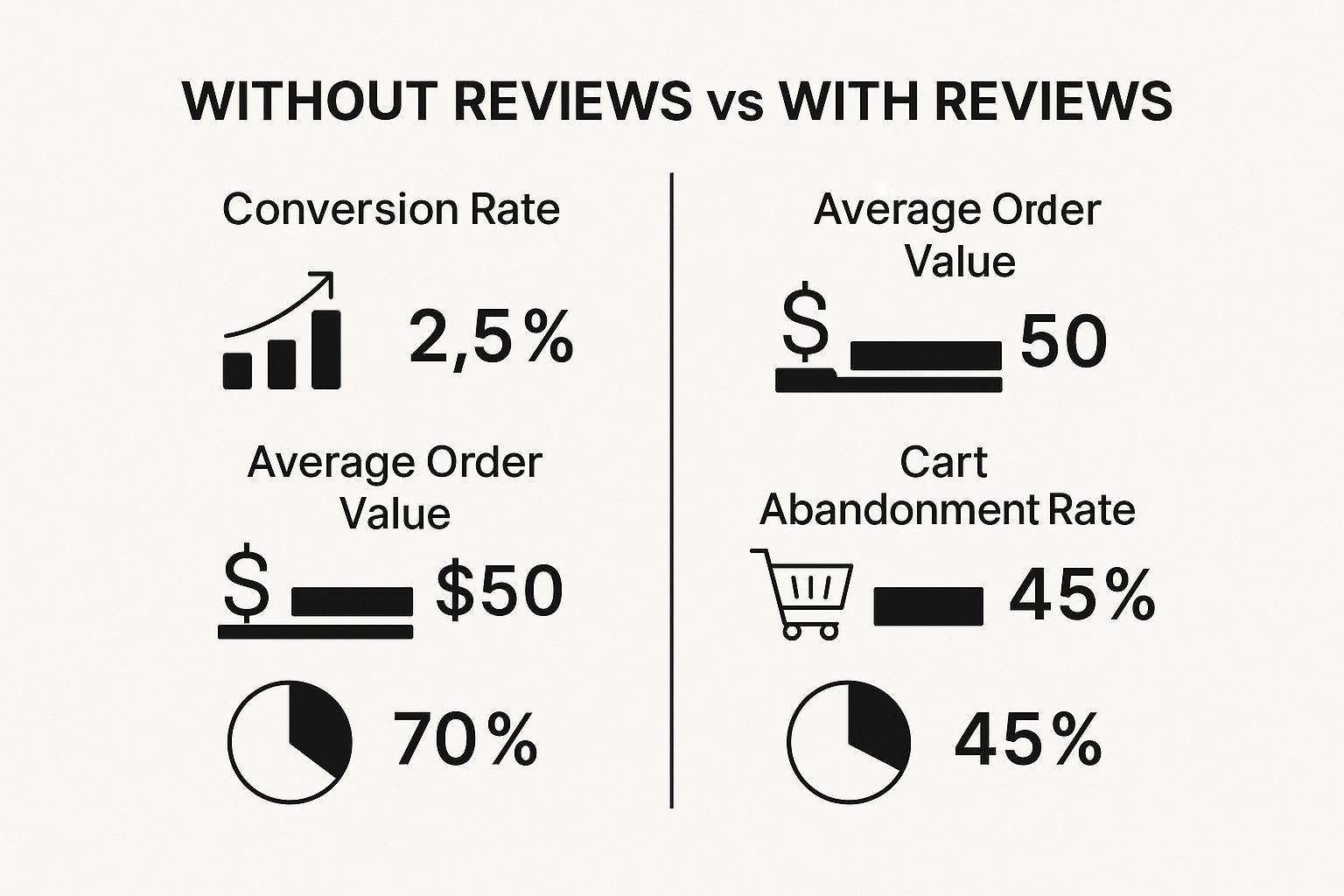
As you can see, integrating reviews nearly doubles the conversion rate, increases the average order value by 50%, and takes a huge chunk out of cart abandonment. It’s powerful stuff.
Pull It All Together with a Multi-Channel Strategy
The true power of smart marketing kicks in when all your channels start talking to each other. What you learn from one area should directly inform your strategy in another.
For instance, say you notice that people on social media are constantly asking about the durability of a particular product. That's a huge signal.
Use that insight to:
- Write a blog post titled something like, "How We Test Our Products for Maximum Durability."
- Create a short video for social media that actually shows the product withstanding some wear and tear.
- Update the product description on your website to specifically call out its long-lasting materials and construction.
You're creating a seamless experience where customer feedback directly improves your marketing, building trust by answering questions before they're even asked.
To give you a better sense of how these channels stack up, here’s a quick comparison.
Marketing Channel Strategy Comparison
This table breaks down some of the most common channels, what they're best for in e-commerce, and what you should be measuring.
| Channel | Primary Goal | Key Tactic Example | Metric to Watch |
|---|---|---|---|
| SEO | Drive organic, high-intent traffic | Optimizing product pages for long-tail keywords | Organic Conversion Rate |
| Email Marketing | Nurture leads & drive repeat purchases | Automated welcome and win-back campaigns | Customer Lifetime Value (CLV) |
| Paid Social | Find and acquire new, targeted customers | Running ads to lookalike audiences | Return on Ad Spend (ROAS) |
| Content Marketing | Build authority and answer customer questions | Creating blog posts based on common support queries | Website Traffic & Engagement |
Choosing the right mix depends on your brand, but a coordinated approach is always more effective than isolated efforts.
The digital marketplace is massive—around 85% of consumers worldwide now shop online, which translates to about 2.77 billion digital buyers. This just underscores how vital a strong, multi-channel presence is. To get a handle on where things are headed, you can discover more insights about digital commerce trends.
By connecting all your marketing efforts, you build a system that doesn't just find new customers but turns them into loyal advocates for your brand.
Making Data-Driven Decisions That Boost Sales

Guesswork is the fastest way to kill your store's growth. If you really want to improve your online sales, you have to stop making assumptions and start listening to what your customers are telling you with their clicks and actions. Making data-driven decisions isn't about becoming a math whiz; it's about turning raw numbers into your most powerful strategic advantage.
This whole process demystifies why some things work and others don't. It comes down to focusing on just a few key metrics that tell the real story of your business's health. Once you understand what they mean and how to act on them, you can make smarter choices that directly boost your bottom line.
Key Metrics That Actually Matter
It’s easy to drown in a sea of data, but honestly, only a handful of numbers give you a clear picture of what’s going on. Instead of tracking every metric under the sun, let's zero in on the ones that have the biggest impact on your revenue.
Think of these three metrics as your essential e-commerce dashboard:
- Conversion Rate: This is the big one—the percentage of visitors who actually make a purchase. It's the ultimate report card on how well your website and product pages are doing their job.
- Average Order Value (AOV): This tells you how much the average customer spends in a single transaction. Bumping up your AOV is one of the quickest ways to grow revenue without needing to find more traffic.
- Customer Lifetime Value (CLV): This number predicts the total amount of money a single customer will spend with you over their entire relationship with your brand. A high CLV is a fantastic sign that you're building loyalty and getting people to come back for more.
Focusing on these core numbers helps you figure out where to put your energy. For instance, a low conversion rate might point to a clunky checkout process, while a low AOV could mean you’re missing out on easy upsell opportunities.
Data tells you a story about your customers. Your job is to listen to that story and use it to make their next experience even better. Every metric is a clue that can lead to more sales.
Find and Fix the Leaks in Your Sales Funnel
Every online store has a "sales funnel"—the path a customer takes from first click to final purchase. And every funnel has leaks, which are just the spots where potential buyers give up and leave. Your mission is to find those leaks and plug them. You don't need fancy software; a free tool like Google Analytics is perfect for this kind of detective work.
A great place to start is your checkout abandonment rate. If you see that 70% of shoppers who add items to their cart are leaving without buying, that’s a massive red flag. Analytics can help you dig deeper to see which specific step is causing the problem. Is it the shipping page? The payment form?
Pinpointing these drop-off points gives you a clear, actionable place to start making improvements. If you want to dive deeper, it's worth understanding the importance of leveraging data analytics for superior digital shelf performance.
Test Your Way to Higher Conversions
So, you've found a problem area. How do you know which fix will actually work? The answer is A/B testing. It's a straightforward method where you create two versions of a page (an 'A' and a 'B'), show them to different groups of visitors, and see which one performs better.
You don't need to test huge, dramatic changes. Sometimes, the smallest tweaks can have a surprisingly big impact on sales.
Here are a few simple A/B tests you can run right away:
- Tweak Your Call-to-Action (CTA) Button: Test the color or the words. Does "Buy Now" outperform "Add to Cart"? Does a bright orange button get more clicks than a subtle blue one?
- Rewrite Your Product Headline: Try leading with a benefit instead of just the product name. For example, you could test a headline like "Get a Perfect Night's Sleep" against "The 'Dream' Memory Foam Pillow."
- Switch Up Your Product Image: See if a lifestyle photo showing your product in action converts better than a clean shot on a plain white background.
The beauty of A/B testing is that it removes ego and guesswork from the equation. The data gives you the final answer on what connects with your audience. This creates a culture of continuous improvement, where every change is a chance to learn something new and grow your sales.
Common Questions on Boosting Online Sales
When you're trying to grow your sales, it's easy to get lost in theory. Let's tackle some of the real-world questions I hear all the time from business owners trying to move the needle.
What's the Fastest Way to Get a Sales Bump?
Everyone wants a quick win, and while big strategies like SEO are crucial for long-term growth, they don't happen overnight. If you need to see a change now, your best bet is to look at your checkout process. Seriously.
Every single point of friction you can remove is a potential sale saved. Think about your own online shopping habits—do you love filling out long forms? Probably not. Offering guest checkout, cutting down the number of steps, and showing multiple payment options right away can immediately lower your cart abandonment rate.
And that rate is a bigger deal than you might think. We're talking about nearly $4 trillion in merchandise left in carts every single year, and a good chunk of that is recoverable. Another fast mover? Run a targeted promotion to your existing email list. Selling to someone who already knows and trusts you is always easier than finding a brand-new customer.
The quickest sales wins rarely come from finding more traffic. They come from converting the traffic you already have. A frictionless checkout is the lowest-hanging fruit you can pick.
How Much Should I Actually Spend on Marketing?
There's no magic formula here, but a good starting point for e-commerce brands is to set aside 5% to 15% of your total revenue for marketing. But honestly, the percentage isn't nearly as important as the results you get.
The number you need to be obsessed with is your Return on Ad Spend (ROAS). Don't feel pressured to throw a huge budget at ads from day one. Start small. Pick one channel you understand, track your results like a hawk, and only scale up your spending once you've proven you have a profitable system.
A pro tip: when you're calculating your returns, think about the lifetime value of a customer, not just the profit from their first order. This perspective shift helps you make much smarter decisions about where to invest your marketing dollars.
I Get Plenty of Traffic, but No One Is Buying. What Do I Fix First?
This is a classic—and frustrating—problem. If people are showing up but not buying, the issue is almost certainly on your website itself. It's time to put on your detective hat and start investigating your product pages.
Here’s where I’d look first:
- Your Visuals and Descriptions: Are your product photos crisp, clear, and compelling? Does your copy sell the feeling and the benefit, or does it just list boring specs? Is your "Add to Cart" button big, bold, and impossible to miss?
- Trust Signals: People are wary of spending money online. You have to earn their trust. Make sure your customer reviews, security badges, and a no-hassle return policy are front and center.
- The User Experience: The best way to find the problem is to see it for yourself. Use a tool that records user sessions on your site. It’s like looking over their shoulder as they shop, and you'll quickly see exactly where they get stuck, frustrated, or just give up.
Pouring more money into ads won't help if your website is a "leaky bucket." You have to patch the holes first before you try to fill it with more traffic.
Ready to turn more of those visitors into paying customers with a 24/7 AI assistant? Yoonoo can automatically answer questions, guide shoppers to the right products, and even help recover abandoned carts. You can set up your own smart chatbot in about five minutes.