Chatbots for Marketing A Complete Guide to Growth
So, what exactly is a marketing chatbot? Think of it as an AI-powered assistant that automates conversations with your customers, whether they're on your website or scrolling through social media. They pop up to engage visitors, answer questions, and gently guide them along, basically acting as an always-on salesperson and support agent for your business. It's the difference between a static brochure and a helpful conversation.
Why Conversational Marketing Matters Now
Take a hard look at your website. For most people who drop by, it's a silent, one-way street. They click around, maybe read a few things, and then disappear—often without you ever knowing who they were or what they were looking for. This old-school approach is like having a beautiful shop with the doors locked. People can window-shop, but they can't come inside and ask for help. This is exactly where chatbots for marketing flip the script.
Today’s customers are all about immediacy. They want answers right now, not in a day or two. Conversational marketing meets them where they are by opening up a direct, real-time chat. It’s a complete shift away from just shouting messages at your audience and toward having actual, helpful dialogues with them.
The Shift from Monologue to Dialogue
At its heart, conversational marketing is all about building relationships, one conversation at a time. Instead of forcing potential customers to hunt through your site for info, you can just offer help the second they need it. It’s a simple change, but it completely transforms the customer experience.
- Immediate Engagement: A chatbot can greet someone the moment they arrive, offering assistance before they have a chance to get frustrated and leave.
- Personalized Journeys: By asking a few quick questions, a bot can figure out what a visitor needs and point them directly to the right article, product, or person.
- 24/7 Availability: Your business doesn't have to sleep. A chatbot is always on duty to capture leads, answer common questions, and support customers long after your team has gone home.
This isn't just another passing trend; it's a real change in how businesses connect with people. You can dive deeper into the core ideas in our guide to what is conversational marketing.
By turning static web pages into interactive experiences, chatbots make your brand feel more human. They don't just spit out information; they create a guided journey that builds trust and helps people make decisions faster.
The Growing Demand for Automated Conversations
The reason chatbots are taking off is simple: they work. In fact, 58% of B2B companies are already using them, a huge jump driven by the need for more efficient and scalable ways to engage customers. The global chatbot market was recently valued at a staggering $7.76 billion and is only expected to climb, which shows just how much businesses are investing in this tech.
Chatbots are a fantastic example of AI changing the marketing game. If you want to see how this fits into the bigger picture, you can learn more about How to Use AI in Marketing. At the end of the day, adding a chatbot isn't just about getting new tech. It's about meeting your customers' expectations and building a business that's more responsive, efficient, and ultimately, more profitable.
How Chatbots Boost Your Marketing Performance
Knowing that chatbots are useful is one thing, but seeing exactly how they move the needle for your business is another. These automated assistants are so much more than a trendy gadget for your website; they are powerful marketing engines working 24/7 to turn casual visitors into engaged leads and loyal customers.
Instead of just talking at your visitors, chatbots pull them into an interactive conversation. This simple shift from a one-way message to a two-way dialogue is where the marketing magic really happens. A chatbot doesn’t just sit there—it proactively engages, qualifies, and nurtures people every step of the way.
The infographic below really drives home how quickly this technology is being adopted and just how big the market has become. It's a clear signal of its importance in any modern marketing plan.
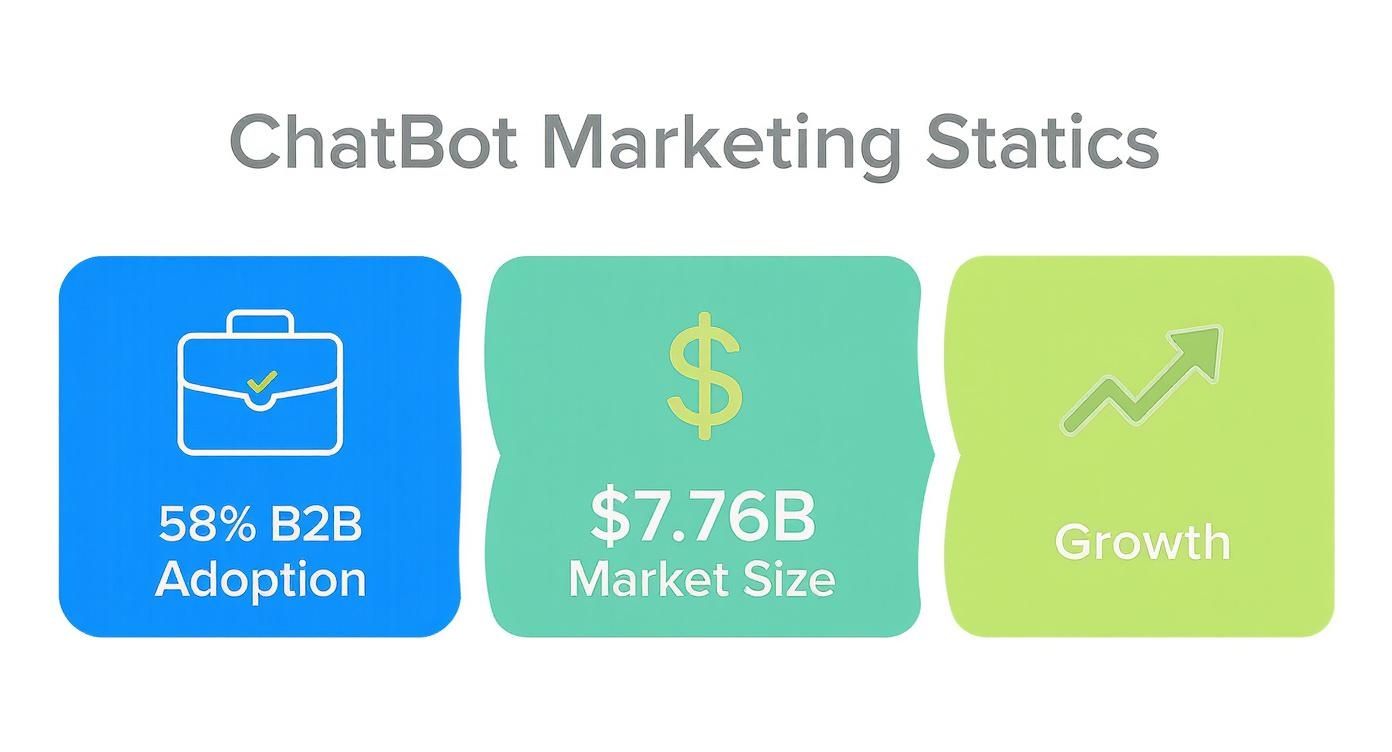
These numbers paint a clear picture. Chatbots aren't just an emerging trend; they’ve become a core part of a winning strategy, especially in B2B where getting that first conversation started is everything.
To see the difference in action, let's compare common marketing tasks with and without a chatbot.
Comparing Marketing Channels With and Without Chatbots
This table shows the direct impact chatbots have on key marketing activities, highlighting the immediate improvements in efficiency, engagement, and data collection.
| Marketing Activity | Traditional Approach (Without Chatbot) | Enhanced Approach (With Chatbot) |
|---|---|---|
| Lead Generation | Visitors fill out static forms and wait for a callback or email. Many leave without converting. | The chatbot engages visitors in real-time, asks qualifying questions, and captures leads conversationally. |
| Customer Support | Customers search FAQs or submit tickets, facing delays. Live agents are limited by business hours. | The chatbot provides instant answers to common questions, 24/7, freeing up human agents for complex issues. |
| User Onboarding | New users navigate the product or service on their own, often relying on help docs or tutorials. | A bot guides new users through key features with interactive, step-by-step instructions. |
| Data Collection | Relies on website analytics (e.g., clicks, page views), which lack context on user intent. | Gathers direct feedback and insights from conversations, revealing pain points and customer language. |
It's pretty clear that adding a chatbot to the mix doesn't just make things faster—it fundamentally changes the quality of your customer interactions for the better.
Automate Your Lead Generation Machine
Traditionally, lead generation meant getting someone to fill out a static form. They land on a page, type in their details, and then... wait. A marketing chatbot completely flips this script, turning a passive task into an active conversation that captures leads way more effectively.
Picture this: someone is browsing your pricing page at 10 PM. A chatbot can pop up and ask, "Trying to find the right plan? I can help you compare." With just a few simple, targeted questions, the bot can qualify that lead on the spot.
- It can figure out their budget and what they need.
- It can get their contact info, like an email, naturally within the chat.
- It can even book a demo right on a sales rep's calendar.
This automated process means no potential customer ever slips through the cracks, no matter the time of day. Your sales team wakes up to a calendar full of qualified meetings, not a cold list of names to chase down.
Deliver Instant Engagement Around the Clock
Your office might close at 5 PM, but your website never does. Today’s customers want answers now, and waiting even a few hours can mean a lost sale. Marketing chatbots act as your tireless, 24/7 frontline team.
They can instantly handle a massive volume of common questions at the same time, from "What's your return policy?" to "How does this feature work?" This frees up your human team to focus on the complex, high-value conversations that actually require a personal touch.
By providing immediate, consistent support, chatbots make for a much better customer experience. That instant gratification builds trust and keeps potential buyers on your site when their interest is highest.
Create Personalized Journeys at Scale
Personalization is the name of the game in modern marketing, but giving every single website visitor a unique experience is a huge challenge. Chatbots solve this by creating personalized conversational paths that adapt to what each user needs.
A chatbot can greet a returning visitor by name, remember their past chats, and suggest products or content based on what they've looked at before. This small touch makes people feel seen and understood. For example, an e-commerce bot might say, "Welcome back! Saw you were looking at running shoes. We just got a new model in that you might love."
This kind of tailored interaction guides people to the right solutions, boosting conversion rates and building real loyalty.
Gather Invaluable Customer Data
Every single conversation a chatbot has is a goldmine of customer data. Unlike anonymous website analytics, these chats give you direct, first-party insights into what your audience is actually thinking. You can learn:
- The most common questions people ask right before they buy.
- The biggest roadblocks or objections holding them back.
- The exact words and phrases they use to describe their problems.
This information is pure gold for refining your entire marketing strategy. You can use these insights to tweak your website copy, write more relevant blog posts, and even develop better products. Your chatbot essentially becomes a non-stop, automated market research tool.
Putting Chatbots to Work Across Your Funnel
A solid marketing funnel is all about guiding someone from "just curious" to "ready to buy." But let's be honest—people get distracted, lose interest, or hit a snag at every step. This is where chatbots for marketing really shine. Think of them as helpful guides stationed at every crucial point in that journey, making sure no one gets lost along the way.
The trick is to avoid a one-size-fits-all approach. A chatbot's job needs to change depending on where someone is in their decision-making process. You wouldn't hit a first-time visitor with a hard sales pitch the second they walk through the door, right? In the same way, your chatbot has to adapt its conversation to match the user's mindset, whether they're just browsing, comparing options, or have their credit card out.
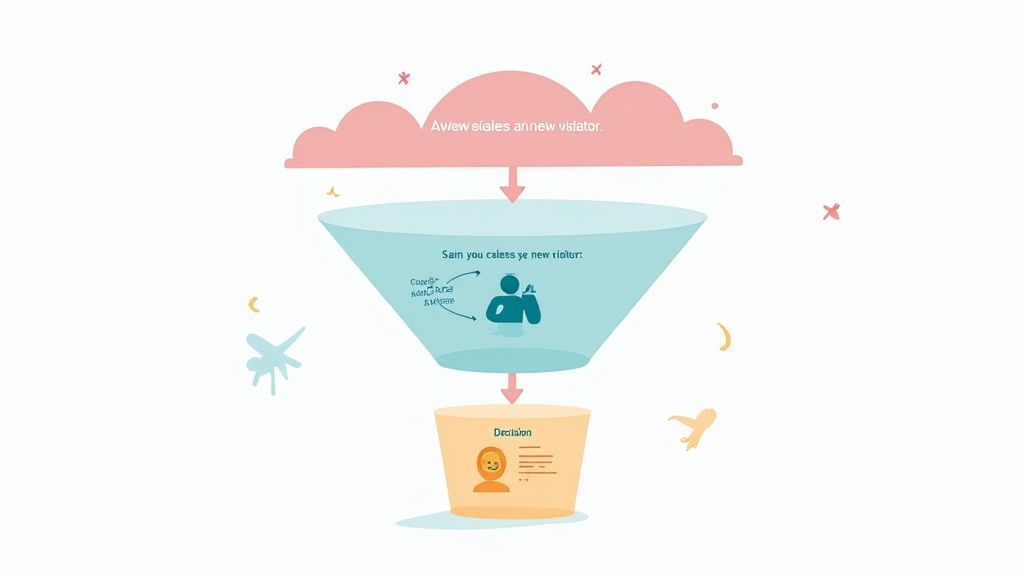
When you deploy them strategically like this, chatbots become more than just a Q&A tool. They transform into a dynamic marketing asset that actively nudges leads from one stage to the next.
Top of Funnel: Engaging New Visitors
At the top of the funnel (ToFu), your goal is simple: grab attention and offer helpful information. People here are usually just starting to explore a problem they have. They definitely aren't ready for a sales pitch; they just want answers. A chatbot in this role acts as a friendly greeter and a smart navigator.
Instead of leaving visitors to wander around your site aimlessly, a chatbot can jump in and offer a hand.
Chatbot: "Hey there! Looking for info on [your topic]? I can point you to our latest guide or show you how our solution helps with [common pain point]. What's on your mind today?"
That one simple interaction can make all the difference. It immediately engages the visitor, cuts down on bounce rates, and gently guides them toward the content they actually want to see. The bot can direct them to blog posts, free downloads, or explainer videos, kicking off the relationship from the very first click.
Middle of Funnel: Nurturing Genuine Interest
Once someone moves into the middle of the funnel (MoFu), things get more serious. They know what their problem is, and now they're actively looking for the right solution. They're comparing you to competitors and have more specific, detailed questions. At this point, the chatbot needs to switch hats—from a greeter to a knowledgeable consultant.
This is your chance to provide real value by answering those deeper questions and building trust.
- Answering Product Questions: The bot can break down specific features, explain pricing, or handle common objections on the spot, freeing up your human team.
- Sharing Case Studies: It can serve up relevant success stories based on a visitor's industry or company size, showing them you've solved similar problems before.
- Registering for Webinars: It can capture a lead by signing someone up for an educational webinar right inside the chat window.
Imagine a visitor is on your features page. The bot could chime in:
Chatbot: "I see you're checking out our integration options. Do you use tools like Salesforce or Slack? I can show you exactly how we connect with them."
This kind of contextual conversation shows you understand their specific needs and builds the confidence they need to stick with your brand.
Bottom of Funnel: Driving the Final Decision
When a potential customer reaches the bottom of the funnel (BoFu), they're on the brink of a decision. They're highly qualified and just need that final nudge. Here, the chatbot's role becomes the deal-closer, removing any last-second friction that could stop a sale.
The focus is all about action and making it incredibly easy for them to buy or get in touch. The use of chatbots at this crucial stage is exploding; millions of people interact with them on business sites, and North America leads the charge, accounting for 31% of the global market share. You can find more fascinating figures in these chatbot adoption statistics on Rev.com.
Here's how a chatbot can seal the deal:
- Offering Targeted Discounts: If someone is hesitating on the pricing or checkout page, the bot can pop up with a time-sensitive offer to encourage them to act now.
- Scheduling Sales Calls: It can sync with your sales team's calendar to book a demo or meeting in real-time. No more "we'll get back to you."
- Streamlining Checkout: For e-commerce, a bot can answer last-minute questions about shipping or returns right on the checkout page, which is a huge factor in reducing cart abandonment.
By automating these final, critical steps, chatbots ensure high-intent leads don't slip through the cracks. They provide the instant support needed to turn a "maybe" into a resounding "yes."
Real-World Examples of Winning Chatbot Strategies
It's one thing to talk about what chatbots can do, but it’s much more powerful to see them in action. Let's look at how real companies are using chatbots to solve real problems, drive sales, and make customers happier.
These aren't just tech-for-tech's-sake examples. Each of these brands found a specific sticking point in their customer's journey and used a chatbot to smooth it out. That's the secret sauce: having a clear purpose from the get-go.
Wembley Stadium Drives Sales with Proactive Support
Imagine trying to manage questions from fans for a 90,000-seat stadium. That’s the challenge Wembley Stadium faced for every event. Their support channels were flooded with questions about tickets, parking, and hospitality, leading to long waits and frustrated fans.
They decided to get ahead of the problem with an AI-powered chatbot that could answer the most common questions on the spot.
- Their Goal: Make the fan experience better by giving instant answers, which in turn would guide people toward buying tickets and hospitality packages.
- How They Did It: They built a "digital concierge" trained on all the event details. The bot was designed to proactively offer help and gently steer conversations toward a sale.
- The Result: The results were massive. The chatbot handled up to 12,000 chats per month and brought in over $1.5 million in revenue in just eight months. It simply made it easier for people who were ready to buy.
This is a perfect example of how a chatbot built for support can become a serious sales engine just by removing friction when it matters most.
IKEA Personalizes Customer Service at Scale
As a global giant, IKEA was drowning in post-purchase customer service requests. Think about it—endless questions about order tracking, delivery times, and damaged items. These are critical questions for the customer, but they're also incredibly repetitive for a support team.
So, they introduced "Billie," an AI assistant built to handle these routine tasks 24/7.
Billie's success shows a core principle of great chatbot strategy: automate the predictable so your team can handle the exceptional. It’s a win for your budget and for customer happiness.
Billie became the first point of contact on IKEA’s contact page, and the numbers are impressive. The bot now fields about 47% of all customer inquiries, which adds up to over 3.2 million conversations and has saved the company nearly €13 million. By taking care of the common stuff, Billie frees up human agents to focus on the trickier issues that need a human touch.
Hairlust Saves Time and Centralizes Communication
Hairlust, a popular online beauty brand, was dealing with customer questions from all over the place—their website, social media, email, you name it. This scattered approach was eating up time and making it tough to deliver a consistent experience.
They used a chatbot to funnel all those conversations into one organized place.
- Their Goal: Free up the support team's time by automating answers and pulling all customer chats into a single conversation hub.
- How They Did It: Using a simple no-code builder, they created chat flows to answer common product questions and guide people from social media back to their main contact page.
- The Result: This simple change saved their team 20% of their time spent on communication. That’s a huge win. Their staff could stop repeating themselves and focus on higher-impact work, proving that a chatbot can be an incredible tool for operational efficiency.
How to Build Your First Marketing Chatbot
Ready to build a chatbot that actually works for your business? The great news is you don’t need a team of developers or a huge budget anymore. With modern no-code platforms, you can build a genuinely helpful marketing chatbot all by yourself, often in just a matter of minutes.
The whole process is way less technical than you'd imagine. It's really more about strategy and clear communication than it is about code. Just think of it like you're designing a simple, guided conversation—one that helps your visitors get what they need while hitting a specific marketing goal for you.
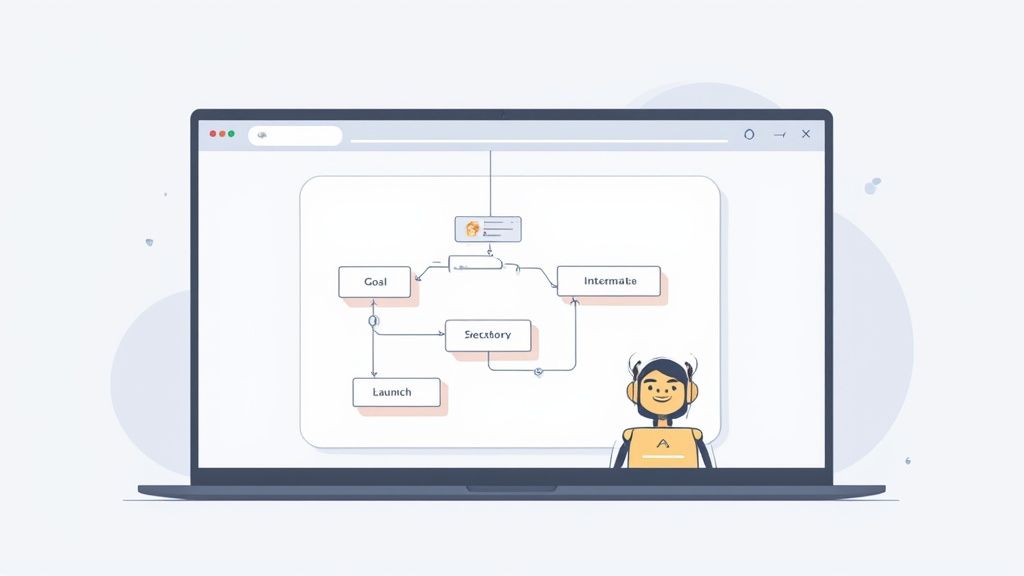
This screenshot shows just how clean and simple a modern chatbot builder can be. The interface lets you focus on the conversation, not complex settings. The trick is to break the process down into a few manageable steps that anyone can follow.
Define One Clear Goal
Before you write a single word, stop and answer this question: What is the #1 job I want this chatbot to do? Trying to make your bot a jack-of-all-trades is a surefire way to create a confusing, frustrating experience for your visitors. Instead, start with one specific goal.
A focused goal keeps the conversation logical and effective.
- Generate qualified leads: The bot can ask a few smart questions to figure out who's a serious prospect and grab their contact info.
- Book sales demos: It can sync right up with your sales team's calendar and get meetings on the books automatically.
- Answer common questions: Let the bot handle all the repetitive stuff about shipping, pricing, or features. This frees up your human support team for the tough questions.
- Guide visitors to key pages: Think of it as a friendly site navigator, pointing people to the perfect blog post, product page, or case study they were looking for.
When you give your chatbot one primary objective, you give it a clear purpose. That makes it far more likely to succeed.
Map a Simple Conversation Flow
Next up, you need to sketch out the conversation. You don't need fancy software for this—a flowchart on a piece of paper or a whiteboard is perfect. Think of it like a choose-your-own-adventure story where you're guiding the user toward your goal.
A great marketing chatbot doesn't try to trick users into thinking it's human. It's clear, helpful, and efficient, guiding users to an answer or outcome with as few steps as possible.
Kick things off with a friendly greeting, then map out the questions and the different ways a user might respond. For a bot designed to generate leads, the flow might look something like this:
- Greeting: "Hi there! Looking for anything in particular today?"
- Qualifying Question: "Are you interested in learning more about [Product A] or [Product B]?"
- Offer Value: "Awesome! I can send you a free guide on that. What's the best email to send it to?"
- Confirmation: "Thanks! Your guide is on its way. Would you like to schedule a quick demo to see it in action?"
See how that simple, logical path makes the whole interaction feel smooth? For a much deeper dive into structuring these conversations, check out our detailed guide on how to build a chatbot from scratch.
Write a Script with Personality
Now for the fun part: writing the actual script. This is your chance to inject your brand’s personality into the conversation. Your chatbot's tone should feel right at home with the rest of your marketing, whether that's buttoned-up and professional or friendly and casual.
Keep your messages short, clear, and easy to scan. Use buttons and quick replies whenever you can, so people can respond with a single click instead of typing. And while this chatbot is for your website, the same principles of automated, helpful responses apply everywhere. For instance, setting up an auto SMS responder for cart recovery is a very similar idea, acting as a specialized chatbot to win back sales.
Finally, always, always include an "escape hatch"—a clear option for the user to connect with a real person if the bot gets stuck. This one little step ensures no one leaves your site feeling frustrated.
Measuring the Success of Your Chatbot
Any good marketing tool needs to prove its worth, and chatbots are no different. Without data, your chatbot is just a neat feature on your website. But with the right numbers, it becomes a powerful, proven asset.
Proving the value of chatbots for marketing isn't about guesswork. It’s about looking at cold, hard data to see exactly how your bot impacts the bottom line. Is it actually generating leads? Are users happy with the experience? Is it saving your team time? Answering these questions justifies the investment and gives you the insights you need to keep improving.
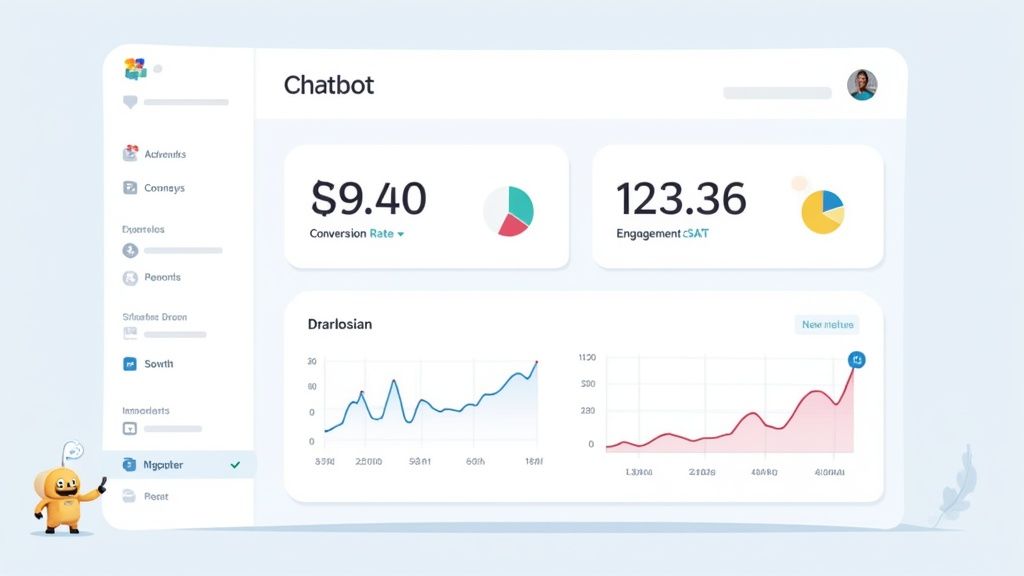
Key Performance Indicators to Track
To really understand how your chatbot is doing, you need to focus on a few key performance indicators (KPIs) that connect directly to your business goals. Don't try to track everything at once—you'll just get lost in the data. Start with the metrics that truly matter.
- Lead Conversion Rate: This is the big one. How many conversations end with a visitor giving you their email or booking a demo? A high conversion rate is a clear sign your bot is successfully turning casual visitors into real prospects.
- User Engagement Rate: Are people actually talking to your chatbot? This metric tells you if your opening lines and prompts are grabbing attention or if users are just ignoring the chat window. It’s the first step in the funnel.
- Customer Satisfaction (CSAT) Score: After a chat, just ask for feedback. A simple thumbs-up or a quick 1-5 rating gives you instant insight into whether people find your bot genuinely helpful or just plain frustrating.
Tracking these three KPIs gives you a well-rounded picture, covering lead generation, user interaction, and overall happiness.
Calculating Your Chatbot ROI
At the end of the day, it all comes down to return on investment (ROI). The good news is, calculating this doesn't have to be a huge headache. You can show a clear return by focusing on the two biggest ways chatbots impact your finances: saving money and making money.
To get a basic ROI, you just need to compare the cost of your chatbot with the value it creates. That value comes from two places: the human hours it saves and the new revenue it brings in.
First, figure out your cost savings. Estimate how many hours your team saves each month by letting the bot handle repetitive questions, and multiply that by their hourly pay. Next, track the revenue generated. This is the value of all the sales that started with a chatbot conversation.
Add those two numbers together, and you have the total value your chatbot delivered. When you put that up against the cost of the platform, you’ve got a clear, simple argument that shows your chatbot isn't just a cost—it's a driver of business growth.
Got Questions? Let's Clear Things Up
Even after seeing all the potential benefits, it's totally normal to have a few nagging questions before you dive in. Let's tackle some of the most common concerns right now so you can move forward with a clear head.
"Will a Chatbot Make My Brand Sound Like a Robot?"
This is probably the number one worry I hear from marketers, and it's a fair one. We all work hard to build a brand voice, and the last thing we want is for a clunky bot to ruin it. But here’s the good news: a robotic-sounding chatbot is a sign of poor design, not a limitation of the technology itself.
The secret isn't trying to fool people into thinking they're talking to a human. It's about designing a helpful, efficient, and pleasant experience that feels true to your brand's personality.
Think about it. Giving your bot a name, using a friendly and familiar tone, and keeping the messages short and to the point—these simple touches make a world of difference. The interaction can feel surprisingly natural.
"What's This Actually Going to Cost Me?"
Next up is the big question: the budget. The cost of a marketing chatbot can range from a cup of coffee to a new car, but the barrier to entry has never been lower.
- Free & Low-Cost Options: Plenty of platforms, including our own at Yoonoo, have free plans or super affordable tiers. These are perfect for small businesses or anyone just wanting to test the waters.
- Mid-Range Solutions: As you get more serious, you can find powerful tools with more advanced features and integrations for a very reasonable monthly investment.
- Enterprise-Level Platforms: For massive companies, custom-built solutions can be a significant investment, but they offer complete control and deep customization.
The point is, there’s a solid option out there for just about every budget. You don't need deep pockets to get started.
"What Are the Biggest Mistakes I Should Avoid?"
Knowing what not to do is just as important. The single biggest mistake I see is building a chatbot without a crystal-clear purpose. A bot that tries to do everything at once usually ends up doing nothing well.
Start small. Pick one specific, high-impact goal, like qualifying new leads or answering the top 5 most common customer questions. Keep the conversation simple and, most importantly, always give users an "out"—a clear and easy way to get in touch with a real person if they need to.
Ready to build a chatbot that actually helps your customers and grows your business? Get started with Yoonoo today and you can launch your first AI assistant in about five minutes. No coding needed, I promise. Check out the plans at https://yoonoo.ai.