Automated Direct Messages to Boost Engagement
So, what exactly are automated direct messages?
Think of them as your own personal, digital concierge for your social media or messaging platforms. They're pre-written messages that get sent out automatically when someone takes a specific action, or "trigger." It's like having a smart assistant who can greet new followers, answer common questions, or send out a special offer without you having to lift a finger. This is how brands create instant, personal connections with their audience on a massive scale—something that would be impossible to do by hand.
What Are Automated Direct Messages Anyway
Imagine trying to personally greet every single person who walks into a huge department store. You just can't do it. But what if you had a friendly, super-smart assistant at the door who could welcome each visitor, ask what they’re looking for, and point them in the right direction? That’s exactly what automated direct messages do for your brand online.
These aren't just random, spammy messages. Not at all. They are timely, relevant messages sent by software that plugs into platforms like Instagram, Twitter (now X), or even SMS. The software waits for a user to do something specific—an action that shows they're interested.
How Triggers Power The Automation
The real secret to making automated DMs work is the "trigger." A trigger is just a specific event that tells your system, "Okay, send this message now!" This makes sure every message feels helpful and relevant to what the user just did, rather than annoying or out of the blue.
Here are a few common triggers:
- Someone follows your account: This is the perfect time to send a warm welcome message.
- A user comments on your post with a keyword: If they comment "info," you can automatically DM them a link.
- A customer makes a purchase: You can instantly send an order confirmation and a quick thank you.
- Someone mentions your brand in their Story: This is a golden opportunity to slide into their DMs and thank them for the shout-out.
This trigger-based system shifts your communication from a generic broadcast to thousands of individual, one-to-one conversations, all happening at the same time.
An automated message should feel like a helpful concierge, not a pushy salesperson. The goal is to provide immediate value based on a user's action, building a foundation of trust from the very first interaction.
It's Bigger Than Just Social Media
While we often think of automated DMs in the context of social media, the idea extends to other direct channels, too. Just look at the direct mail advertising market. It’s projected to hit a whopping $69.37 billion in 2025, largely thanks to software that uses real-time data to send personalized campaigns. You can read more about the future of direct mail automation and see how this trend is growing.
This growth proves one simple thing: people value timely, relevant communication, no matter where it comes from. Once you understand what automated DMs really are, you stop seeing them as a shortcut and start seeing them as an essential tool for building meaningful connections in a very crowded digital world.
The Real-World Benefits of DM Automation
It’s one thing to know what automated DMs are, but seeing what they can actually do for a business is where things get exciting. A smart automation strategy can completely change how you talk to your audience, grow your following, and turn followers into customers.
This isn't just about saving a few minutes. It's about unlocking new ways to be efficient and create genuine connections, all at the same time. Let’s dive into the real advantages you’ll see when you put this technology to work.
Unlocking Time and Efficiency
Right away, the biggest win with DM automation is getting back your team's most valuable resource: time. Manually replying to every new follower, every comment, and every common question is a huge time sink. It’s repetitive work that pulls people away from things that really move the needle—like planning your next big campaign, creating amazing content, or handling tricky customer problems.
Think of automation as a digital assistant who works 24/7 handling the routine stuff. This frees up your team to focus on what humans do best, which means better productivity and a whole lot less burnout.
Achieving Massive Scalability
Could you have a personal, one-on-one chat with a hundred people at the exact same time? Of course not. But for an automated system, that’s easy.
That’s the magic of scalability. Automation lets you engage with thousands of people at once without skipping a beat.
- Welcome every single new follower with a personalized message the second they hit "follow."
- Run a promotion by sending a unique discount code to everyone who comments a keyword on your post.
- Get feedback by instantly messaging every customer who tags you in a story.
Being able to scale these kinds of intimate conversations is impossible to do by hand. It gives even a small shop the power to communicate like a huge brand.
Automation turns your DMs from a one-to-one bottleneck into a one-to-many channel that still feels personal and immediate for everyone.
Enabling Hyper Personalization at Scale
Good automation isn’t about blasting the same generic message to your entire list. It’s about sending the perfect message to the right person at exactly the right moment. You do this with trigger-based personalization. By setting up simple rules based on what people do, you make sure every single message feels relevant and timely.
For example, if someone comments "shoes" on your post, they get a different automated DM than the person who comments "hats." This makes your brand feel incredibly attentive and helps build a much stronger connection with your audience.
Improving Lead Nurturing and Conversions
At the end of the day, you want to guide potential customers toward making a purchase. Automated DMs are an incredible tool for this. You can build entire message sequences that nurture leads along their buying journey—all without you lifting a finger.
A well-planned DM flow can ask questions to qualify leads, share helpful info, and then smoothly point them to a product page or a sales rep when the time is right. For example, a simple https://yoonoo.ai/blog/chatbot-for-small-business can answer initial questions and collect contact details, turning a casual question into a genuine lead. This process keeps your brand top-of-mind and seriously boosts your conversion rates by making the path to purchase as smooth as possible.
Choosing the Right Platform for Your Campaign
Your automated DM strategy is only as good as the platform you run it on. This isn't about just picking the most popular social network; it’s about knowing where your audience actually spends their time and what kind of conversations they’re open to having there.
Think about it: a fun, emoji-filled welcome message that kills it on Instagram would feel totally weird and out of place on LinkedIn. Likewise, a super urgent flash sale alert sent via SMS would probably get buried in a busy Facebook Messenger inbox. To really nail this, you have to match your platform to your marketing goals and how people naturally behave on each channel.
This isn't just about saving a few minutes, either. Shifting from manual to automated DMs can dramatically lift your performance across the board—think better open rates, lightning-fast response times, and more sales.
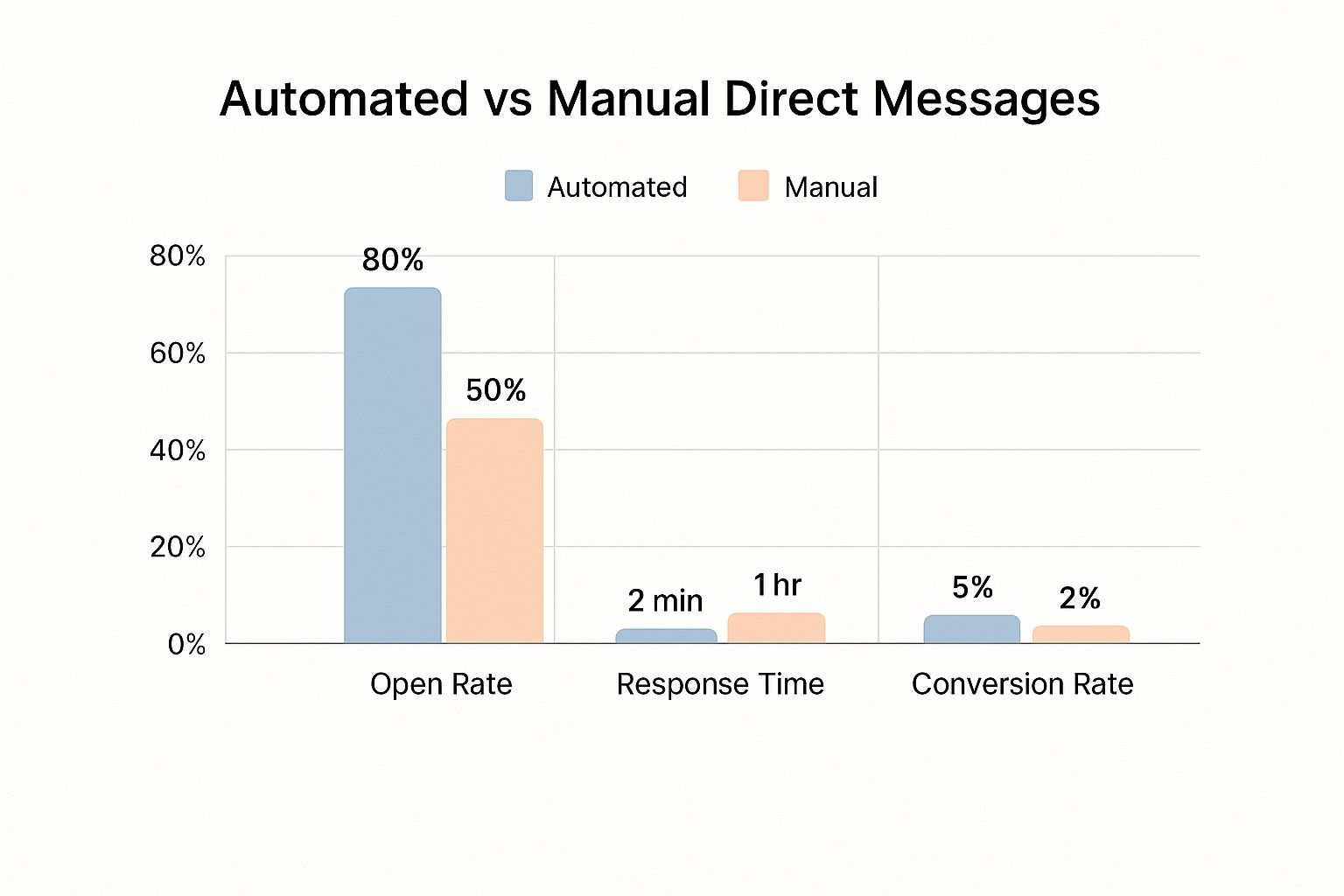
The numbers don't lie. Automation delivers tangible results by creating faster, more engaging interactions that guide people toward becoming customers.
Platform Comparison for Automated Direct Messages
Choosing the right channel can feel overwhelming, but it gets easier when you break it down by what each platform does best. This table gives you a quick side-by-side look at the top contenders, so you can see where your brand fits in.
| Platform | Best Use Case | Typical Open Rate | Key Advantage |
|---|---|---|---|
| E-commerce & Brand Building | 70-80% | High visual engagement and direct shopping integration. | |
| B2B Lead Nurturing | 50-60% | Access to a professional audience focused on value. | |
| Twitter (X) | Real-Time Engagement & CS | 60-70% | Speed and direct access to trending conversations. |
| SMS | Urgent & Time-Sensitive Alerts | 98% | Unbeatable immediacy and near-guaranteed visibility. |
As you can see, there’s no single "best" platform—only the one that’s best for your specific goal. A brand driving ticket sales for an event has very different needs than a SaaS company nurturing enterprise leads.
Instagram: A Visual Playground for Ecommerce
Instagram is all about visuals, making it a goldmine for e-commerce, retail, and creator-driven brands. People are scrolling to discover new things and connect with brands they love. This makes it the perfect spot to engage new followers and drive sales with interactive, automated DMs.
Best Use Cases for Instagram:
- Welcoming New Followers: The moment someone follows you, send an instant DM with a warm welcome and maybe a small discount. It’s a fantastic first impression.
- Story Mention Replies: Someone tags your brand in their Story? Automatically thank them. It’s a simple way to build a loyal community.
- Keyword-Triggered Product Info: Post a picture of a new product and tell followers to comment "SHOP." An automated DM will instantly send them a direct link to buy.
This simple automation turns passive browsers into active shoppers, moving them from discovery to checkout without them ever having to leave the app.
LinkedIn: The Hub for B2B Professionals
LinkedIn is where business gets done. It's the world’s biggest professional network, and the entire vibe is centered on career growth, industry knowledge, and B2B connections. Conversations here are more formal and need to provide real value.
On LinkedIn, automation should feel like a helpful assistant, not a pushy salesperson. Your goal is to offer valuable resources, share insights, and build professional trust over time.
For any B2B company, automated direct messages on LinkedIn are a game-changer. You can automatically follow up after a new connection accepts your request by sharing a relevant case study, or invite them to an upcoming webinar. It's perfect for nurturing high-value leads with a thoughtful sequence of messages that establishes your credibility.
Twitter (X): The Arena for Real-Time Conversation
Twitter, or X, is all about speed. It’s where news breaks and trends catch fire in real-time. The people here expect quick, witty, and to-the-point interactions.
Brands can use automated DMs on X to run giveaways, provide instant answers for common customer service questions, or share exclusive links with followers who engage with a specific post. The key is to be immediate and brief—your automation needs to match the rapid-fire pace of the platform.
SMS: The Unbeatable Channel for Urgency
When a message absolutely, positively has to be seen right now, nothing beats SMS. Text messages pop up directly on a user's lock screen, demanding attention in a way no social media DM can. This makes it the undisputed champion for any time-sensitive message.
The reach is just massive—globally, SMS can connect with 5 billion people. And the engagement numbers are incredible, with open rates hovering around 98% and response rates of 45%. Those stats blow most other digital channels out of the water. You can discover more insights about text marketing statistics on TxtCart.
This channel is perfect for things like:
- Flash sale announcements.
- Appointment reminders.
- Shipping and delivery notifications.
But here’s the catch: because SMS is so personal, you must have explicit permission to text people. Use it wisely and sparingly to avoid coming across as spam. When you match the right message to the right platform, your communication isn't just seen—it's welcomed.
How to Craft Messages That Actually Connect
An automated message should never feel automated. The real secret to effective automated direct messages is making people feel like you're talking directly to them, even when a system is sending the message. This takes more than just flipping a switch; it requires a bit of strategy and a human touch.
Your goal isn't just to send a notification—it's to start a conversation. A great automated DM feels personal, genuinely helpful, and, above all, human. Let's break down how to write messages that build real connections.
Define a Clear Goal for Every Message
Before you type a single word, ask yourself: "What do I want this message to do?" Without a clear goal, your message is just noise in someone's inbox. Every automated DM needs a specific job.
Are you trying to...
- Drive traffic? Then your message needs a clear and compelling link to a specific page.
- Get feedback? You should ask a simple, direct question that’s a breeze to answer.
- Welcome a new follower? The goal is to make a fantastic first impression, maybe even offer a little something to say thanks.
Once you know your "why," crafting the rest of the message becomes so much easier. This simple step is the bedrock of any successful messaging strategy.
Think of each automated message as a digital handshake. It should be warm, confident, and have a clear purpose, setting a positive tone for the entire relationship.
Nail the Tone and Voice
The biggest mistake brands make is sending automated DMs that sound like they were written by a corporate lawyer. Remember where you are—you're in their personal inbox, a space usually reserved for friends and family. Your tone needs to match that environment.
Keep it conversational and friendly, in a way that aligns with your brand's personality. This doesn't mean you have to load it with slang, but it does mean you should ditch the stiff jargon and overly formal language. A good rule of thumb? Write like you talk.
If you're ever in doubt, read your message out loud. Does it sound like something a real person would actually say? If it feels awkward or robotic, it's time for a rewrite.
The Power of Personalization Tokens
Personalization is the difference between a welcome message and a spammy one. Using a person’s name is the easiest and most powerful way to make them feel seen. Most automation tools let you use personalization tokens like {first_name} to drop in user details automatically.
Look at the difference this one small change makes:
- Generic: "Hey! Thanks for the follow. Check out our new collection."
- Personalized: "Hey, Sarah! So glad to have you here. We thought you might like our new collection."
The second example feels like a one-on-one chat. It instantly builds rapport and shows you see them as a person, not just another number in your follower count.
This focus on direct, personal connection is a growing trend. In fact, a recent study found that 82% of companies increased their spending on direct mail and similar personalized campaigns. Marketers are seeing real results from it, and you can discover more insights about direct mail spending trends on Postalytics.
Create a Strong Call to Action
Don't leave people hanging. Every message should gently guide them on what to do next. Your Call to Action (CTA) shouldn't be a demand; it should feel like an invitation. Make it clear, compelling, and super simple to act on.
- Weak CTA: "Click here."
- Strong CTA: "Tap here to get your 15% off!"
Use action-oriented words and always spell out the benefit for the user. Whether you're asking them to visit your site, reply with a keyword, or watch a video, your CTA is what turns their interest into action.
Add Personality with Visuals
Finally, don't be afraid to show a little personality! A well-placed emoji or GIF can break up a wall of text, add emotion, and make your brand feel more human and relatable.
Of course, this depends on your audience. The visuals a law firm uses will be very different from what a streetwear brand might send. But no matter your industry, a little visual flair can help your automated direct messages stand out and connect on a deeper level.
Common Mistakes That Can Wreck Your Reputation
Automated DMs are a fantastic tool for connecting with people, but like any powerful tool, you have to know how to use it. When things go wrong, they can go wrong fast, souring your followers and tarnishing the reputation you’ve spent so long building. Think of it like a sports car—if you don't respect its power, you're going to end up in a ditch.
Let's walk through the most common pitfalls so you can avoid them entirely. Knowing what not to do is the first step toward creating an automation strategy that actually builds relationships instead of burning bridges.
Over-Automating and Sounding Like a Robot
The absolute biggest mistake is making your audience feel like they're talking to a wall. When every interaction is automated and there’s no clear way to reach a real person, your followers will feel trapped and unheard. This is especially damaging when they have a complex or sensitive problem that a bot just can't handle.
The whole point of automation is to free up your team to have more meaningful conversations, not to eliminate them completely. It’s meant to assist, not replace.
The Fix: Always give people an out. A simple "Reply with 'human' to chat with our team" can make all the difference. Just make sure someone is actually there to pick up the conversation. It’s a small thing that shows you’re listening and that you care.
Sending Generic, Untargeted Blasts
There's a razor-thin line between a helpful message and pure spam. Blasting the same generic DM to everyone on your followers list is the quickest way to jump over to the wrong side. This approach completely ignores why a person followed you or what they're interested in, making your messages feel irrelevant and annoying. The result? Unfollows and mutes.
A McKinsey study pointed out that companies that don't respond see a 15% higher churn rate. While that’s about no response, sending an irrelevant message feels just as bad—it tells the user you aren't actually paying attention.
An automated message without context is just noise. Real engagement happens when you’re relevant, and relevance comes from responding to something the user actually did or showed interest in.
Ignoring the Platform's Rules
Every social media platform has its own rulebook for automation and DMs. Ignoring them isn't just bad manners; it’s a great way to get your account flagged, restricted, or even shut down for good. These platforms are always tweaking their policies to keep users safe from spammy and aggressive marketing.
Playing fast and loose with the rules puts your entire social media presence on the line. You have to stay on top of the dos and don'ts for every platform you're on.
Common violations to avoid:
- Sending too many messages too quickly: This is a classic spam trigger.
- Blasting unsolicited promos: Most platforms require the user to interact with you first.
- Not offering an opt-out: People need a simple way to say "stop."
Forgetting to Check Your Stats
Finally, a massive error is the old "set it and forget it" approach. Kicking off an automation campaign without ever looking at the results is like driving with your eyes closed. You have no clue what’s connecting with people, what’s falling flat, or how your audience is even reacting.
You can't get better if you don't know what's happening. You could be sending messages with broken links, confusing instructions, or a tone that just isn't landing right.
The Fix: Check your analytics regularly. Keep an eye on metrics like open rates, click-through rates, and especially reply rates. Use that data to tweak your copy, timing, and offers. This is how you continuously refine your strategy for automated direct messages and start seeing much better results.
How to Set Up Your First Campaign with Yoonoo
Alright, enough with the theory—let's get our hands dirty. Now that you know the thinking behind great automated DMs, I'll show you just how easy it is to launch your first campaign using Yoonoo. We'll skip the jargon and walk through it step-by-step.
The goal here is simple: get you from an idea to a live automation in just a few minutes. Think of this as your personal launch guide for building real connections with your audience, right away.
Step 1: Connect Your Social Accounts
First things first. Before Yoonoo can work its magic, you need to connect your social media accounts. This is a quick, one-time setup that gives Yoonoo secure permission to send messages for you.
Just head over to the "Integrations" section in your dashboard and follow the prompts for Instagram, Facebook, or whatever platform you're using. The whole thing is secure and takes less than a minute. It’s like building the bridge between your social profiles and your new automation tool.
Step 2: Choose Your Automation Trigger
Next, we need to tell Yoonoo when to send a message. This is your trigger—the specific action a user takes that starts the automation. A good trigger is everything, as it makes sure your message shows up at the perfect moment.
Yoonoo gives you a few powerful options to choose from:
- New Follower: The perfect way to instantly welcome someone to your community.
- Keyword in Comment: See someone comment with "info" or "deal" on a post? This trigger sends them a DM automatically.
- Story Mention: Automatically thank people who tag your brand in their Instagram Stories.
For your first campaign, welcoming new followers is a fantastic and simple place to start. It’s a high-impact, low-effort win.
Your trigger is what separates a helpful message from an annoying one. Pick an action that clearly shows someone is interested in what you have to offer.
Step 3: Write and Personalize Your Message
Now for the fun part: writing the actual message. Yoonoo’s editor is straightforward. Just remember what we talked about—keep it conversational, let your brand’s personality shine, and give people a clear next step.
Don't forget to use personalization tokens to make it feel like a one-on-one chat. Adding a simple {{first_name}} tag automatically pulls in the user's first name, which makes a huge difference.
You can even create a follow-up sequence. For instance, if someone doesn't reply to your welcome message, Yoonoo can send a gentle nudge two days later. It's an easy way to keep the conversation going without you having to lift a finger. And for more advanced conversations, you can always explore using an AI customer support chatbot to handle the heavy lifting.
Step 4: Keep an Eye on Your Results
Once you're live, you're not done. Just "setting and forgetting" is how you miss out on big improvements. Yoonoo's analytics dashboard gives you a crystal-clear picture of how your campaign is doing.
You can easily check the numbers that matter:
- Open Rates: Are people actually reading your DMs?
- Click-Through Rates (CTR): Is your call to action working? This tells you how many people are clicking your links.
- Reply Rates: How many people are writing back? This is a great sign of an engaging message.
Watching these metrics helps you tweak your automated direct messages over time, turning good results into great ones.
Got Questions? We've Got Answers
Diving into automated DMs can bring up a few questions. It’s smart to get the full picture before you jump in, so you can build a strategy that’s both powerful and responsible. Let's clear up some of the most common things people ask.
Will Using Automation Get My Account Banned?
This is probably the biggest question on everyone's mind, and for good reason. The short answer is: not if you do it right.
Social media platforms are cracking down on spammy, robotic behavior, not on smart, helpful automation. As long as you stick to the golden rules—sending personalized messages, avoiding blasting thousands of people at once, and always offering real value—you're in the clear.
Think of it this way: the goal is to use automation to start a genuine conversation, not to just shout into the void. Tools built with platform guidelines in mind are designed to keep your account safe.
How Do I Actually Measure the ROI?
Figuring out if your automated DMs are working is about more than just seeing who opened them. To really understand your return on investment (ROI), you need to connect your DM activity to actual business results.
Here's what you should be tracking:
- Click-Through Rate (CTR): Are people actually clicking the links you send? This is a great indicator of how compelling your message is.
- Conversion Rate: Of the people who clicked, how many actually followed through? Did they sign up for your webinar, use the discount code, or buy the product?
- Lead Generation: How many quality conversations turned into solid leads for your sales team? This is where the money is made.
What’s the Right Number of Messages to Send?
There's no one-size-fits-all answer here, but the principle is simple: add value, don't be annoying.
The best way to get the frequency right is to let your audience's actions guide you. Messages that are triggered by something they did—like following you, commenting on a post, or making a purchase—almost always feel welcome and timely.
When you're sending out a proactive message, start slow. See how people respond. If you notice engagement dropping or people opting out, that's your cue to ease up.
Ready to start building smarter conversations and connecting with your audience around the clock? Get started with Yoonoo and launch your first AI chatbot in just five minutes—no code needed. Create your free account today!